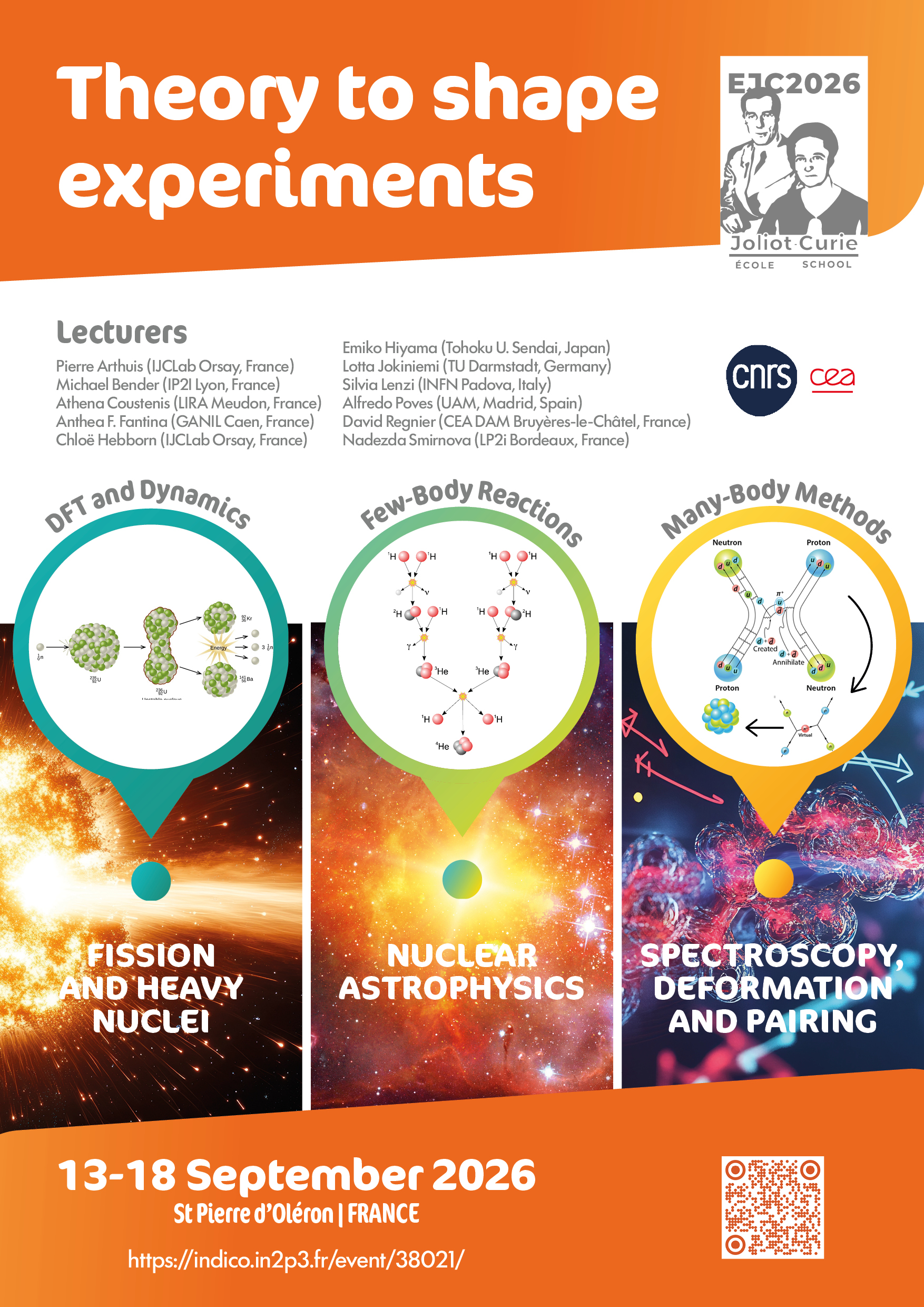
EJC 2026: Theory to shape experiments

Europe/Paris
Saint-Pierre d'Oléron

Saint-Pierre d'Oléron

Description

The Joliot Curie European School, founded in 1982 within IN2P3, is France’s leading school in nuclear physics. Its primary mission is to train PhD students, postdoctoral researchers, and permanent staff—both researchers and engineers—on recent advances across all fields of nuclear physics studied at IN2P3.

In 2026, the theme will be « Theory to Shape Experiments. » We will explore theoretical developments, drawing on the extensive expertise available at CNRS/IN2P3 and CEA. However, the goal is not to propose a school « for theorists » alone, but rather to engage a broader audience of experimental and theoretical physicists. Together, we will discuss recent progress in describing nuclei and nuclear matter, identify the most promising observables to constrain models, and explore the most fruitful avenues for future research.

Collaboration is a key focus of this school. By fostering interaction among early-career researchers, we aim to inspire ambitious joint projects and strengthen collaborative networks.

The lectures will be organized around thematic physics topics, which will serve as a foundation for discussing various theoretical methods:

  • Density Functional Theory (DFT) and Dynamics / Fission and (Super)heavy Nuclei
  • Few-Body Reactions / Nuclear Astrophysics
  • Many-Body Methods / Spectroscopy, Deformation, and Pairing


****************************

L’école européenne Joliot Curie, fondée en 1982 au sein de l’IN2P3, est l’école de référence en France pour la physique nucléaire. Elle a pour objectif de former en priorité les doctorants et post-doctorants mais aussi les personnels permanents chercheurs et IT aux avancées récentes sur tous les domaines liés à la physique nucléaire et étudiés au sein de l’IN2P3.

En 2026, le sujet sera « Theory to Shape Experiments ». Nous discuterons donc des développements théoriques en tant que tels en nous appuyant sur les nombreuses expertises présentes au CNRS/IN2P3 mais aussi au CEA. Le but n’est cependant pas de faire une école « pour les théoriciens » mais pour un public plus large de physiciens expérimentateurs et théoriciens afin de discuter ensemble des avancées récentes dans la description des noyaux et de la matière nucléaire, de discuter des meilleures observables à même de contraindre les modèles et de réfléchir aux voies les plus prometteuses à explorer dans les années à venir. Il est important d’intégrer cet aspect collaboratif au sein du vivier de jeunes chercheurs afin de les inciter ensuite à entreprendre des projets communs ambitieux dans un cadre collaboratif.

Les cours seront organisés selon des thématiques de physique qui seront utilisées comme support pour discuter les différentes méthodes théoriques :

  • Théorie de la Fonctionnelle de la Densité (DFT) et Dynamique / Fission et noyaux (super)lourds
  • Réactions à quelques corps / Astrophysique Nucléaire
  • Méthodes à N corps / Spectroscopie, Déformation and appariement

________________________________


Infos oléron
Registration
Pre-registration
    • 4:30 PM
      Bus pickup
    • 6:45 PM
      Dinner
    • Colloquium
      • 1
        Space exploration of the solar system and beyond
        Speaker: Athéna Coustenis (CNRS - Paris-Meudon Observatory)
    • Lecture: Monday morning
      • 2
        Introductory Lecture
        Speaker: Silvia Lenzi (University of Padua and INFN)
      • 10:00 AM
        Break
      • 3
        Astrophysics and EOS
        Speaker: Gianluca Colò (Dipartimento di Fisica, Università degli Studi, and INFN, Milano)
    • 12:00 PM
      Lunch
    • 1:30 PM
      Free time
    • Lecture: Monday afternoon
      • 4
        Introductory Lecture
        Speaker: Silvia Lenzi (University of Padua and INFN)
    • 5:30 PM
      Break
    • Poster session
    • 7:30 PM
      Dinner
    • Lecture: Tuesday
      • 5
        Nuclear EDF and Heavy Nuclei
        Speaker: Michael Bender (IP2I)
      • 10:00 AM
        Break
      • 6
        Astrophysics and Reactions
        Speaker: Chloë Hebborn (CNRS - IJCLab)
    • 12:00 PM
      Lunch
    • 1:30 PM
      Free time
    • Module: Tuesday
      Convener: Chloë Hebborn (Université libre de Bruxelles)
      • 7
        Nuclear Reactions
        Speaker: Chloë Hebborn (CNRS - IJCLab)
      • 5:45 PM
        Break
      • 8
        Few-Body Systems
        Speaker: Emiko Hiyama (RIKEN and Tohoku Uni.)
    • Dinner
    • Lecture: Wednesday
      • 9
        Nuclear Structure
        Speaker: Lotta Jokiniemi (TUD)
      • 10:00 AM
        Break
      • 10
        Astrophysics and EOS
        Speaker: Gianluca Colò (Dipartimento di Fisica, Università degli Studi, and INFN, Milano)
    • 12:00 PM
      Lunch
    • 1:30 PM
      Excursion
    • Poster session
    • 7:30 PM
      Dinner
    • Lecture: Thursday
      • 11
        Dynamics of Heavy Nuclei
        Speaker: David Regnier (CEA)
      • 10:00 AM
        Break
      • 12
        Shell Model and Nuclear Structure
        Speaker: Alfredo Poves (Departamento de Física Teórica and IFT UAM-CSIC, Universidad Autónoma de Madrid)
    • 12:30 PM
      Lunch
    • 1:30 PM
      Free time
    • Module: Thursday
      • 13
        Ab Initio Methods
        Speaker: Pierre Arthuis (CNRS - IJCLab)
      • 5:45 PM
        Break
      • 14
        Shell Model
        Speaker: Nadezda Smirnova (Laboratoire de Physique des Deux Infinis Bordeaux)
    • 7:30 PM
      Dinner
    • Lecture: Friday
      • 15
        Nuclear Structure
        Speaker: Lotta Jokiniemi (TUD)
      • 10:00 AM
        Break
      • 16
        Dynamics of Heavy Nuclei
        Speaker: David Regnier (CEA)
    • 12:00 PM
      Lunch
    • 1:30 PM
      Bus dropoff