École Normale Supérieure Summer Institute 2026

Europe/Paris
ENS

ENS

24 Rue Lhomond -- room Conf IV 2nd floor 75005 Paris, France
Giuseppe Policastro (LPTENS), Marc Henneaux (Université Libre de Bruxelles & Collège de France), Miguel Fernandes Paulos (Ecole Normale Superieure), Philine VAN VLIET (ENS Paris)
Description

We are looking forward to welcoming you to the 2026 edition of the ENS Summer Institute. The ENS Summer Institute aims to cover a broad spectrum of topics in high-energy physics and cosmology, and provide ample opportunities for discussion. 

This year, it will include topics on holography, quantum gravity and particle physics.
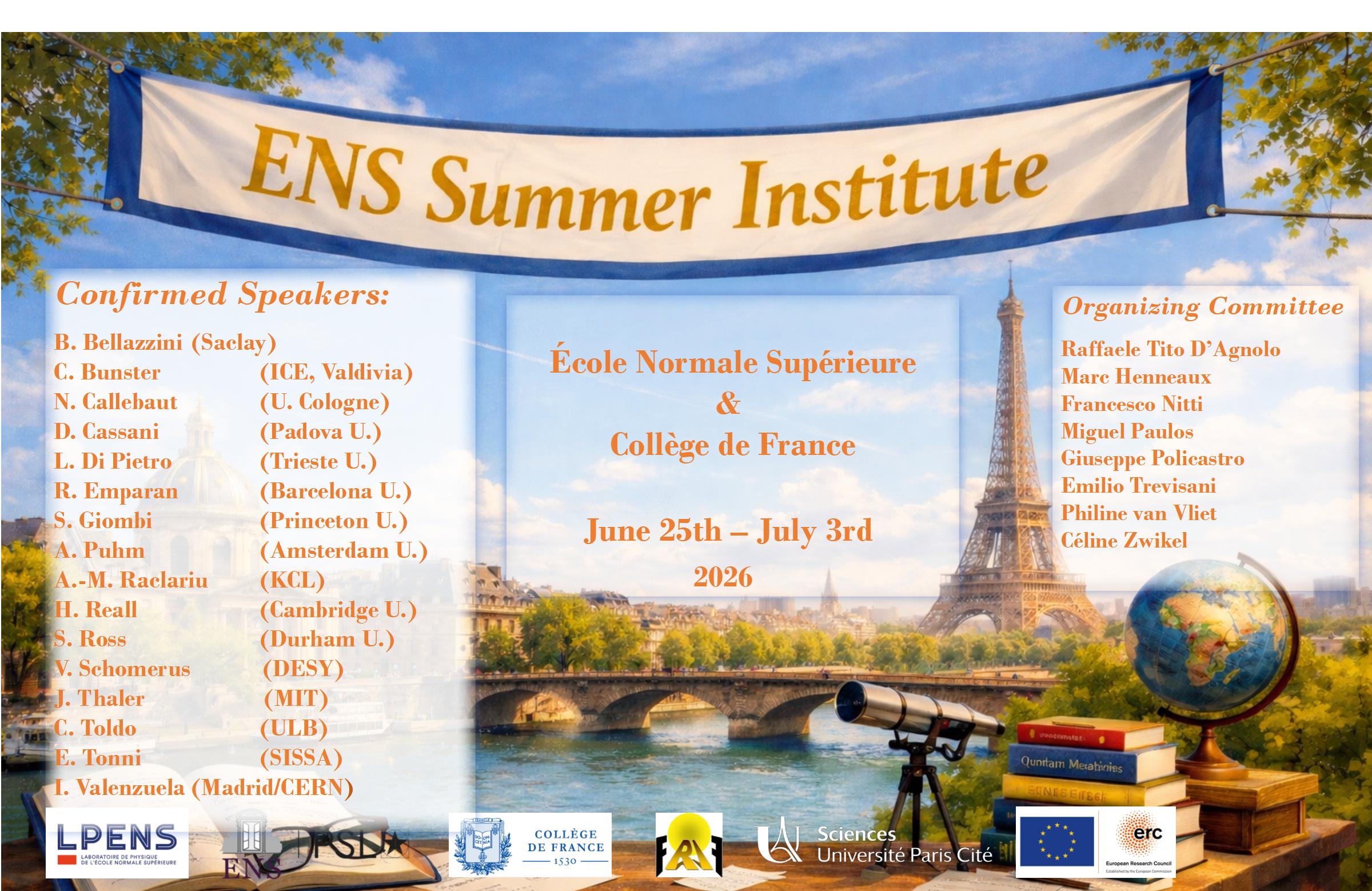
Location: 75005 Paris

25-26 June: 11, place Marcelin-Berthelot,  salle 2 (Collège de France)

29 June- 03 July: 24 rue Lhomond, room Conf IV, 2nd floor, Erasme building (LPENS)

Recent past editions: 2025, 2024, 2023, 2018, 2017

Inscription
Registration
    • 10:30
      Coffee Break
    • 1
      The third law of black hole mechanics Salle 2 (College de France)

      Salle 2

      College de France

      11, place Marcelin-Berthelot

      The third law of black hole mechanics asserts that it is impossible for a non-extremal black hole to become extremal in finite time (in classical General Relativity). Counterexamples were found recently: gravitational collapse of a massless charged scalar field can produce an exactly extremal Reissner-Nordstrom black hole in finite time, passing through an intermediate phase in which the solution is exactly Schwarzschild at the horizon. These examples involve matter with a large charge to mass ratio. I will describe how if the charge to mass ratio of matter is suitably bounded then one cannot form an extremal Reissner-Nordstrom black hole in finite time. It is conjectured that one can form an extremal rotating black hole via gravitational collapse of gravitational waves. I shall describe recent work showing that this conjecture is true in five spacetime dimensions.

      Orateur: Harvey Reall
    • 2
      Braneworld holography from TTbar flows Salle 2 (College de France)

      Salle 2

      College de France

      11, place Marcelin-Berthelot, salle 2 (Collège de France)

      I will present our systematic study of braneworld holography, with a focus on the 3D/2d case, in which we identify what has been referred to as the 'cut-off CFT' in braneworld holography literature with a $T\bar T$-deformed CFT, and the effective gravity theory on the brane with a $T\bar T$-like deformed timelike Liouville theory. In the limit of the brane approaching the asymptotic boundary, this Liouville theory describes the holographic Weyl anomaly of the undeformed holographic CFT. Our approach is based on solving the radial gravitational Hamiltonian flow, and leads to an effective theory that allows application of the island rule for non-asymptotic branes.

      Orateur: Nele Callebaut
    • 15:00
      Coffee Break
    • 10:30
      Coffee Break
    • 3
      The black hole at the end of the cone: localizing the anomaly polynomial on toric geometries Salle 2 (College de France)

      Salle 2

      College de France

      11, place Marcelin-Berthelot, salle 2 (Collège de France)

      Anomalies are known to govern the asymptotic growth of states in CFTs through Cardy-like formulae and to play a central role in the thermodynamics of BPS black holes. In this talk, we discuss a new manifestation of this connection. We consider five-dimensional supergravity, gauged or ungauged, and propose a method based on equivariant integration of the anomaly polynomial to evaluate the on-shell action of supersymmetric black saddle solutions with toric $U(1)^3$ symmetry and general topology, including higher-derivative corrections. We show that the resulting action determines the Wald entropy of supersymmetric black holes, black rings, and black lenses, both asymptotically flat and asymptotically $\text{AdS}_5$. This yields a simple derivation of known expressions and leads to new predictions.

      Orateur: Davide Cassani
    • 4
      Descending into the Modular Bootstrap Salle 2 (College de France)

      Salle 2

      College de France

      11, place Marcelin-Berthelot, salle 2 (Collège de France)

      The modular bootstrap has been a powerful tool for carving out the landscape of allowed two-dimensional conformal field theories (CFTs). In this talk, I describe a complementary approach to standard modular bootstrap bounds: using modern machine learning strategies to actively search for CFT spectra that yield a valid torus partition function. Using insights from statistical inference and a custom singular-value-based optimizer, I present evidence for an obstruction to finding CFTs with small central charge and large spectral gaps, and I speculate on what this might imply for the structure of the CFT landscape. Along the way, I reflect on "centaur" approaches to theoretical physics, where human physicists and artificial intelligence collaborate to explore spaces of theories that would be difficult to navigate alone.

      Orateur: Jesse Thaler
    • 15:00
      Coffee Break
    • 10:30
      Coffee Break
    • 5
      Bounds on Symmetry Breaking and other Swampland Constraints
      Orateur: Irene Valenzuela
    • 6
      Observing quantum gravity at macroscopic horizon scales

      It has often been assumed that quantum gravity effects near a macroscopic black hole horizon should be strongly suppressed due to the enormous hierarchy between the horizon scale and the Planck scale, and that any observable deviations would require highly speculative or poorly controlled non-local physics. However, it has recently become clear that this expectation can fail in a controlled and physically interesting way. In particular, near-extremal black holes can exhibit enhanced quantum fluctuations that become manifest through a variety of physical effects. I will discuss several such effects in this talk.

      Orateur: Roberto Emparan
    • 15:00
      Coffee Break
    • 7
      From trees to loops in celestial CFT

      Symmetries impose powerful constraints on the structure of theories that are holographical dual to quantum gravity in the bulk spacetime. I will review recent progress on the structure of two-dimensional celestial CFTs conjectured to be dual to quantum gravity in four-dimensional asymptotically flat spacetimes where the set of symmetries underlying the universality of gravitational scattering in the infrared is particularly rich. Central to this the celestial operator product expansion (OPE), derived from the collinear limit of bulk scattering amplitudes, which for soft graviton operators determines the celestial symmetry algebra. While the discussion in the literature has mostly focused on tree-level soft physics, the long-range nature of gravitational interactions requires us to understand the implications of loop corrections. I will discuss our current understanding of those, present a new method for computing the celestial OPE at tree and loop level based on the consecutive double soft limit, and comment on the implications of these results for the structure of celestial CFT.

      Orateur: Andrea Puhm
    • 8
      Thermal entropy and entanglement transitions from modular objects

      The reduced density matrix of a spatial subsystem can be written as the exponential of the modular Hamiltonian (a.k.a. entanglement Hamiltonian) and its eigenvalues provide the entanglement entropy. Hence, this operator contains a lot of information about the entanglement of the corresponding spatial bipartition. Within Algebraic Quantum Field Theory, the modular Hamiltonian and the modular conjugation are two essential tools of the Tomita-Takesaki modular theory,

      In the first part of this talk, it is shown how the modular conjugation in a 2D CFT at finite temperature provides the thermal entropy of a single interval of finite length. Within the AdS/CFT correspondence, the gravitational dual interpretation of this result in terms of geodesic bit threads is also discussed, including its extension to higher dimensions for the case where the spatial subsystem is supported in a spherical region.

      In the second part of the talk, considering the harmonic chain in its ground state and in large mass regime, the entanglement Hamiltonian of two disjoint blocks is explored, showing the it displays geometric transitions as the distance between two blocks of fixed lengths changes.

      Orateur: Erik Tonni
    • 15:00
      Coffee Break
    • 9
      Multiparty entanglement and holography

      Entanglement plays a central role in our understanding of the emergence of spacetime in holography. There is growing evidence that many holographic states have significant multiparty entanglement. I will discuss some signals of multiparty entanglement, and their behaviour in holographic states.

      Orateur: Simon Ross
    • 10:30
      Coffee Break
    • 10
      Detector Amplitudes and Positivity Bounds

      Long-range interactions in four-dimensional flat spacetime pose a challenge for positivity bounds and S-matrix bootstrap programs, because infrared divergences trivialize ordinary scattering amplitudes. In this talk, I will introduce stripped, or detector, amplitudes: IR-finite avatars of standard amplitudes that retain analyticity, crossing symmetry, and Regge boundedness, while depending on a physical detector scale. When this scale is taken exponentially smaller than all other scales in the problem, detector amplitudes also obey a suitable form of unitarity. This makes it possible to derive IR-finite positivity bounds for effective field theories in the presence of long-range interactions.

      Orateur: Brando Bellazini
    • 11
      Interfaces in Symmetric Product Orbifolds and Holography

      Conformal interfaces are attracting growing attention across quantum field theory, holography, and integrability. While interfaces in higher-dimensional gauge theories—such as gauge-group-changing interfaces in N=4 super Yang–Mills theories—have been studied extensively, much less is known about interfaces in symmetric orbifold conformal field theories.

      Symmetric product orbifolds are a remarkable class of two-dimensional CFTs, sharing many features with large-N gauge theories and playing a central role in tensionless holography. In this talk, I will present a construction of interfaces between symmetric product orbifolds with different orbifold groups and discuss the computation of some key observables. I will also describe their holographic interpretation and explore connections to integrability. The exploration of these interfaces and their role in holography is only just beginning. Some future directions will be discussed at the end.

      Orateur: Volker Schomerus
    • 15:00
      Coffee Break
    • 10:30
      Coffee Break
    • 12
      CFT in AdS and boundary criticality

      By conformally mapping a boundary conformal field theory (BCFT) to anti-de Sitter space, one obtains a natural framework for studying boundary critical phenomena. The different conformal boundary conditions of the CFT, corresponding to distinct boundary universality classes, have a natural description in AdS, which also provides a powerful approach for the calculation of various BCFT observables. I will focus on the classic example of the Wilson-Fisher fixed point of the $O(N)$ model with a boundary, and review the calculation of the free energy and of certain one-point functions at higher-loops in the epsilon expansion. From a suitable dimensional continuation of the AdS free energy, one can extract estimates for the central charge of the BCFT in $d=3$, which are in good agreement with recent results from the fuzzy sphere regularization method. If time permits, I will also discuss the application of a similar AdS approach to the Gross-Neveu-Yukawa universality class.

      Orateur: Simone Giombi
    • 13
      Quantum corrections to near extremal black hole thermodynamics

      In this talk I will describe how recently developed techniques allow to compute the quantum corrections to the entropy of near-extremal black holes, by regularizing certain zero-modes appearing in the gravitational path integral in the near horizon geometry. I will show that the quantum-corrected near-extremal entropy exhibits 3/2 log T behavior characteristic of the Schwarzian model, and predicts the lifting of the ground state degeneracy for the extremal Reissner-Nordstrom black hole. I will then explain the subtleties arising when applying these techniques to the Kerr solution and to warped $\text{AdS}_3$ black holes. For the latter case, I will show that Newman-Penrose formalism is a useful tool for bridging the near horizon geometry picture to the full black hole one.

      Orateur: Chiara Toldo
    • 16:00
      Coffee Break
    • 09:30
      Coffee Break
    • 14
      On bulk reconstruction in Lorentzian AdS and its flat space limit

      We revisit the reconstruction of a free scalar in 4-dimensional Lorentzian Anti-de-Sitter spacetime in terms of primary operators in the boundary 3d CFT. We show that the positive and negative energy subspaces of solutions to the Klein–Gordon equation in AdS can be spanned with bulk-to-boundary propagators with appropriate time orderings. As a result, free scalar fields on a codimension-1 bulk hypersurface can be expressed in terms of operators integrated over boundary regions in the past or future of the hypersurface with kernels given by time-ordered or anti-time-ordered propagators. We will explain how to obtain a similar decomposition of the free field in terms of boundary operators transforming in representations of an $so(3,1)$ subalgebra of the 4d AdS isometry algebra by constructing the appropriate wavefunctions. We conclude by showing that the expansion of a free scalar in Minkowski space in plane wave, Carrollian and conformal primary bases follow from these results in various flat space limits.

      Orateur: Ana-Maria Raclariu
    • 11:00
      Coffee Break
    • 15
      Two Applications of SSB in AdS

      I will discuss the definition and the consequences of Spontaneous Symmetry Breaking (SSB) for a quantum field theory on a rigid Anti-de Sitter (AdS) background. In particular I will review the existence of a (trivial) conformal manifold, and explain how to compute its metric from the two-point function of the bulk current. I will then discuss two applications: (1) to quantum electrodynamics in 3d, where the possible pattern of symmetry breaking involving the flavor and magnetic symmetries can be studied reliably in perturbation theory when the AdS radius is small; (2) to the subleading strong coupling expansion of the Bremsstrahlung function of the $1/2$ BPS Wilson-Maldacena line in $\mathcal{N}=4$ SYM, which can be computed from the two-point function of the tilt operator, using a judicious treatment of SSB on the $\text{AdS}_2$ worldsheet to fix the normalization and get a finite result.

      Orateur: Lorenzo Di Pietro