IRN Terascale @ IJCLab Orsay
Auditorium Pierre Lehmann
IJCLab
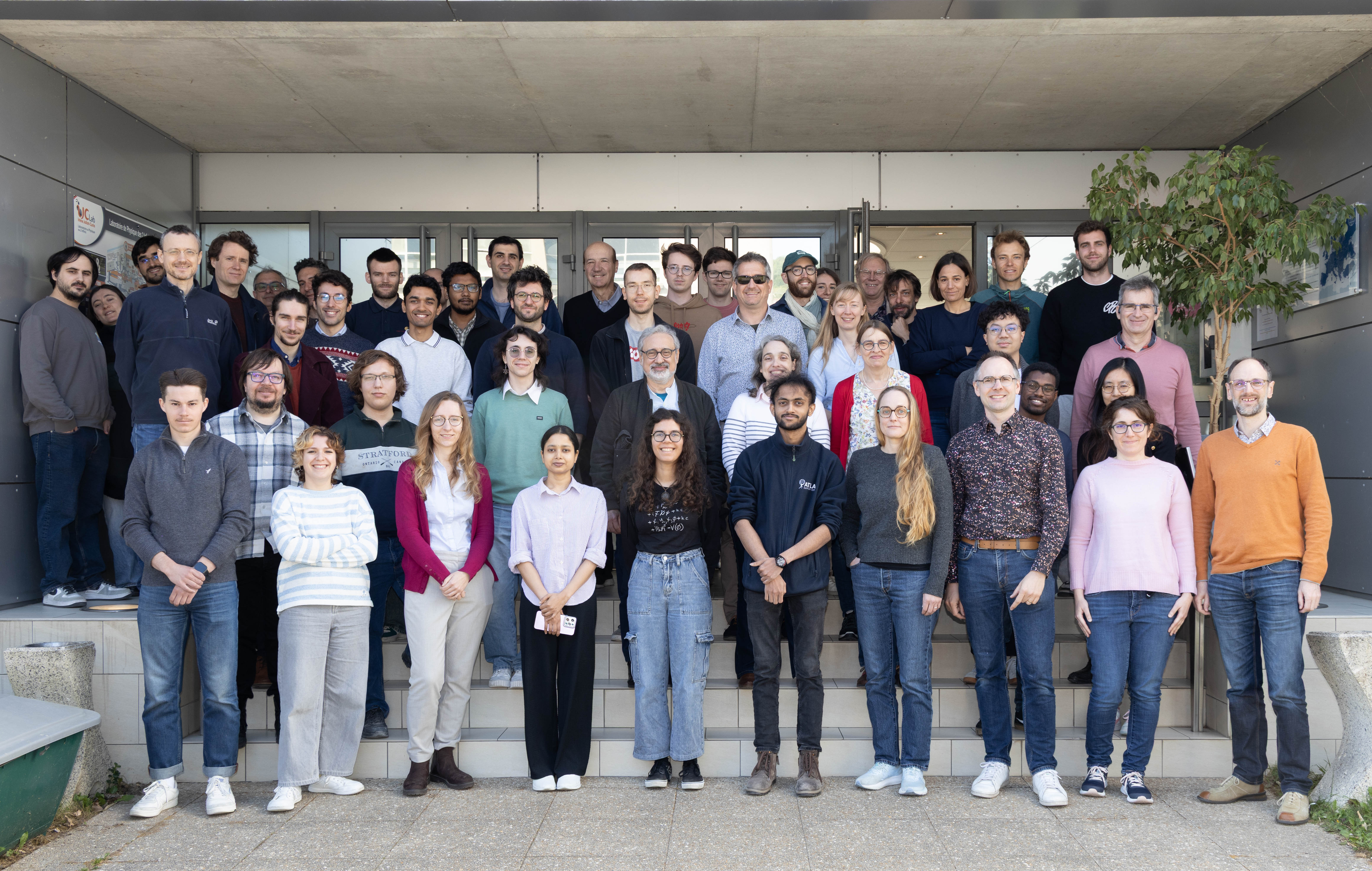
We are looking forward to welcoming you for the spring meeting of the IRN Terascale at IJCLab Orsay, from April 20-22nd 2026, in the Lehmann auditorium in Building 200.
Abstract submission and registrations are open, until March 30th for the abstracts and April 6th for the registration.
For any questions regarding the corresponding session, please contact the group conveners:
More information at terascale.in2p3.fr
-
-
1
Introduction & welcome Auditorium Pierre Lehmann
Auditorium Pierre Lehmann
IJCLab
Building 200, IJCLab -
Beyond the Standard Model Auditorium Pierre Lehmann
Auditorium Pierre Lehmann
IJCLab
Building 200, IJCLab-
2
Challenging Majorana Neutrino Effects in B→K(∗)νν and K→πνν Decays
The $B\to K \nu \nu$ decays are among the cleanest rare processes in the Standard Model (SM), as they are dominated by short-distance contributions. Recently, the Belle-II experiment has observed this process for the first time, with a branching ratio that lies $\approx 3\sigma$ above its SM prediction. Such deviation can be consistently accommodated in an Effective Field Theory (EFT) scenario with operators made with SM neutrinos. At dimension-six, the relevant operators simply rescale the SM branching ratio, while higher-dimensional operators can modify the di-neutrino invariant-mass distribution. In this talk, we will show that the latter scenario generically induces sizable contributions to neutrino masses through Renormalization Group evolution, thus leading to severe fine-tuning problems. As an alternative, we consider an EFT with a light sterile neutrino, which avoid the fine-tuning issue in neutrino masses, while still leading to a potential distortion of the di-neutrino spectrum that can be tested experimentally at Belle-II.
Orateur: Claire Chevallier (IJCLab - Université Paris Saclay) -
3
Reinterpretation of searches for supersymmetry in models with variable R-parity-violating coupling strength using the full ATLAS Run 2 Dataset
This work reinterprets thirteen existing searches for supersymmetry (SUSY) conducted by the ATLAS Collaboration using the full Run 2 dataset from the Large Hadron Collider. Unlike traditional analyses that assume fixed R-parity scenarios, the study considers SUSY models with variable R-parity-violating (RPV) coupling strengths, allowing the lightest supersymmetric particle to exhibit either prompt or long-lived decays. Using proton–proton collision data at √s = 13 TeV with an integrated luminosity of 140 fb⁻¹, the analysis sets limits on several SUSY particle masses, including gluinos, top squarks, tau sleptons, and electroweakinos. The results significantly extend existing constraints, excluding gluino masses up to ~2.5 TeV depending on the coupling regime, top squark masses up to 2.4 TeV, and Higgsino masses up to about 1 TeV. By incorporating both prompt and long-lived signatures, this study broadens sensitivity beyond conventional R-parity-conserving scenarios and improves coverage of a wide class of SUSY models.
Orateur: Lorenzo Feligioni (in2p3) -
4
Prospects of Heavy Neutral Leptons via ALP portal at future LHC
Heavy neutral leptons (HNLs) and axion-like particles (ALPs) are both well-motivated candidates for beyond the Standard Model (BSM) physics. ALPs with couplings to gluons can be abundantly produced at the LHC. Therefore, HNLs produced via the ALP portal may provide unprecedented sensitivity to HNL parameters. In this talk, I will present the sensitivities of ATLAS and future far detectors to these long-lived HNLs at the high-luminosity LHC, considering different ALP mass regimes and their distinct phenomenological features and theory consideration.
Orateur: Ana Martín-Galán (IFIC (CSIC-Univ. Valencia)) -
5
What is the 650 GeV resonance made of ?
Nine statistically significant decay channels are observed in LHC data around a mass of 650 GeV. We interpret three of them as coming from a narrow resonance observed in e+e-, 2 photons and ZZ which could be a J=2 Kaluza Klein graviton resonance called T690 (T for tensor with J=2). This hypothesis is reinforced by noting that this signal disappears in ZZ when treated as a scalar. Assuming a Randall Sundrum RS model, we conclude that LHC observes the predicted sequence T376, T690 and T1000. At variance with the RS model, T690 weakly couples to gluon pairs, suggesting a composite model interpretation. Perturbative unitarity requirements predict T++->W+W+ and T+->ZW resonances, again indicated by LHC data.
Orateur: Francois Richard (LAL/Orsay)
-
2
-
15:45
Break Auditorium Pierre Lehmann
Auditorium Pierre Lehmann
IJCLab
Building 200, IJCLab -
Beyond the Standard Model Auditorium Pierre Lehmann
Auditorium Pierre Lehmann
IJCLab
Building 200, IJCLab-
6
Observable gravitational waves from TeV-scale horizontal SU(2) phase transitions
We investigate a flavoured horizontal gauge extension of the Standard Model (SM), and demonstrate that first-order phase transitions (FOPTs) generically arise during its TeV-scale symmetry breaking. These FOPTs occur only for flavour gauge couplings $g_f \sim \mathcal{O}(1); beyond this, one-loop corrections to the quartic interaction start to dominate the thermal potential and weaken the transition. To obtain reliable predictions for the resultant gravitational-wave (GW) signal, we match each phase transition to its steady-state hydrodynamical solution, capturing out-of-equilibrium plasma effects through an effective friction parameter primarily sourced by soft flavour gauge boson interactions with the SM plasma. Within this framework, we identify both runaway solutions for sufficiently strong FOPTs and regimes in which the interplay between hydrodynamics and friction leads to enhanced GW production despite a reduction in the transition strength. We find that the resulting stochastic GW signals can lie within the sensitivity band of next-generation detectors such as the Einstein Telescope.
Orateur: Anna CHRYSOSTOMOU (LPTHE) -
7
Anomalies, Radiative Hierarchies and Dark Matter in Secluded U (1) Extensions
U(1) extensions of the Standard Model have received significant attention.
However, concrete examples with anomalies in the effective low-energy
theory remain scarce.
We present a model with three main features. First, it includes a
hierarchy between fermions charged under the new U(1) and the new gauge
boson, leading to an apparent anomaly at low energies. Second, it provides
a viable Dark Matter candidate. Third, it improves gauge coupling
unification.
The construction includes a secluded fermion sector with N families of
vector-like Standard Model-like representations. We discuss the
limitations of a minimal implementation and introduce viable examples.
The parameter space is explored using machine learning algorithms. We
derive constraints from Dark Matter direct detection and collider
searches.Orateur: Arno Goudeau (LPTHE, Sorbonne University) -
8
Phenomenology of colour sextet baryons in composite Higgs models
Composite Higgs theories with partial compositeness are gauge theories in which the Higgs boson arises as a pseudo Nambu Goldstone boson (pNGB), and top partners appear as bound states of three hyperfermions originating from a fermionic UV completion. These models offer a promising solution to the naturalness problem of the Higgs sector and predict additional pNGBs and vector-like baryons at or above the TeV scale.
In this talk, we consider models that, in addition to the usual colour triplet top partners, also predict sextet states.
We analyze their LHC phenomenology and, in particular, we show that pair production yields signatures containing up to eight top quarks.
Using recasts of existing LHC searches, we derive current constraints on their masses.Orateur: Rosy Caliri (University of Würzburg) -
9
Signatures of a Standard Model duality
The Standard Model may emerge as the effective low energy limit of a simpler UV theory via gauge duality. I will discuss how a non-supersymmetric duality on QCD (akin to Seiberg dual in SQCD) can lead to a viable Standard Model. New low energy states are predicted, close to a supersymmetric spectrum, while flavour structures are cast into flavour-full Higgs fields. Potential signature software this framework may be found at the LHC around the TeV scale.
Orateur: Dr Giacomo Cacciapaglia (LPTHE)
-
6
-
Scientific management committee meeting Auditorium Pierre Lehmann
Auditorium Pierre Lehmann
IJCLab
Building 200, IJCLab
-
1
-
-
Higgs and Electroweak Auditorium Pierre Lehmann
Auditorium Pierre Lehmann
IJCLab
Building 200, IJCLab-
10
Combined effective field theory interpretation of VBS measurement with ATLASOrateur: Zhuoran Feng
-
11
Latest results on differential cross-section with H->ZZ->4l leptons channel with CMS Run 3 data.Orateur: Martina Manoni (LLR)
-
12
Measurement of ttH (H->multilepton) production at ATLAS
The associated production of a top-quark pair with the Higgs boson is one of the few processes allowing to probe the Higgs Yukawa coupling to the top quark in a direct way, providing an important test of EW symmetry breaking.
The ATLAS measurement of ttH in multilepton final states, which uses the full Run 2 dataset of proton-proton collisions at $\sqrt{s}=$13TeV by the ATLAS detector, will be presented. Besides the measurement of the inclusive ttH cross-section, a differential ttH cross-section measurement in bins of the Higgs transverse momentum in the simplified template cross-section framework and a simultaneous fit of tH and ttH are performed. Finally, the CP structure of the top quark-Higgs boson Yukawa coupling is probed through the analysis of ttH and tH events.Orateur: Gianna LOESCHCKE CENTENO
-
10
-
10:45
Group Picture Auditorium Pierre Lehmann
Auditorium Pierre Lehmann
IJCLab
Building 200, IJCLabIn front of B200
-
10:50
Break Auditorium Pierre Lehmann
Auditorium Pierre Lehmann
IJCLab
Building 200, IJCLab -
Higgs and Electroweak Auditorium Pierre Lehmann
Auditorium Pierre Lehmann
IJCLab
Building 200, IJCLab-
13
Latest results on Higgs mass measurement with H->gamma gamma decay channel with CMSOrateur: Paul Gaigne
-
14
Measurement of the ttHH process with the ATLAS experimentOrateurs: Arthur LAFARGE (Université Clermont Auvergne (FR), LPCA (Clermont-Ferrand)), Arthur Lafarge (Université Clermont Auvergne (FR), LPCA (Clermont-Ferrand))
-
15
ss production in future linear collidersOrateur: Jesus Pedro MARQUEZ HERNANDEZ (IJCLAB (CNRS))
-
13
-
16
Tackling next HEP computing and data challenges Auditorium Pierre Lehmann
Auditorium Pierre Lehmann
IJCLab
Building 200, IJCLabOrateur: Sabine Crépé-Renaudin (CNRS/IN2P3/LPSC) -
13:10
Lunch
-
Methods and Tools Auditorium Pierre Lehmann
Auditorium Pierre Lehmann
IJCLab
Building 200, IJCLab-
17
SMEFT NLO correction to Higgs decaying to fermion pairs implementation Sherpa
Leveraging the Large Hadron Collider (LHC) data and the SMEFT framework, study the properties of Higgs boson is now an active research program. However, the robust analysis hinges on the inclusion of higher order (NLO) Electroweak (EW) and QCD corrections arising from dimension-6 SMEFT operators for a more accurate picture. While significant progress has been made in calculating NLO QCD corrections within SMEFT, and some EW corrections exist, there is a crucial gap: a lack of event generators incorporating these corrections for optimal data analysis. This talk addresses this gap by proposing the implementation of these corrections into an event generator like Sherpa.
Orateur: Shakeel Ur Rahaman (IPPP, Durham University) -
18
Study of Neutral-Current Drell-Yan process with POWHEG: Impact of NLO EW effects and sin2thetaW
The NCDY process is sensitive to NLO EW effects and to the value of sin2thetaW, which manifest themselves differently on the Z peak and at high invariant mass. In this, we present a practical and physics-oriented study based on POWHEG-BOX-V2 (Z_ew-BMNNPV), with emphasis on how to configure and validate NLO electroweak simulations. We discuss a reproducible workflow to control the relevant POWHEG settings and to generate event samples suitable for preliminary physics analyses.
We compare multiple electroweak input schemes, including $\alpha$(0), $G\mu$ with Mw input, and $G\mu$ with $sin^2(\theta_W)$ input, and quantify their impact across dilepton mass regions from the Z peak to the TeV scale. The final goal is to assess the sensitivity of high-mass observables to the scale evolution of sin2thetaW and to provide a validated POWHEG strategy for precision measurements.Orateur: Mohamed Berkat (CEA Saclay) -
19
Information Theory meets QCD
We begin by reviewing how NLL accuracy is achieved in modern parton showers, highlighting the recent Sherpa implementation, and then introduce our new information-theoretic matching framework to achieve beyond NLL accuracy. By minimizing a Kullback–Leibler functional under constraints set by precision QCD input observables (including theory uncertainties), we embed high-order predictions into fully differential, particle-level simulations with strictly positive event weights and the ability to impose multiple observable constraints simultaneously. We futher discuss HDSense a new efficient tool that approximates the full Fisher information matrix for observable selection to maximize sensitivity to underlying QCD parameters.
Orateur: Ben Assi (University of Cincinnati) -
20
Exploring the BSM parameter space with Simulation-Based Inference method
Sampling parameter spaces of beyond-the-Standard-Model (BSM) scenarios is computationally challenging due to high dimensionality, complex likelihoods, and stringent experimental constraints. We explore likelihood-free, neural network-based Simulation-Based Inference (SBI) methods to address this problem, focusing on three amortized approaches: Neural Posterior Estimation (NPE), Neural Likelihood Estimation (NLE), and Neural Ratio Estimation (NRE). Their performance is evaluated using the Test of Accuracy with Random Points (TARP), posterior sample efficiency, and computational cost. Applied to the scalar sector of the phenomenological MSSM (pMSSM), NPE yields accurate posterior distributions with minimal samples and outperforms MCMC. Extending to a 9-parameter pMSSM with dark matter observables, the efficiency decreases but the amortized SBI framework continues to produce reliable posteriors, identifying viable points that are predominantly bino-dominated up to $\sim 1.5$ TeV and wino-dominated between 1.5-2 TeV.
Orateur: Arpita Mondal (Laboratory of Subatomic Physics & Cosmology)
-
17
-
16:00
Break Auditorium Pierre Lehmann
Auditorium Pierre Lehmann
IJCLab
Building 200, IJCLab -
Methods and Tools Auditorium Pierre Lehmann
Auditorium Pierre Lehmann
IJCLab
Building 200, IJCLab-
21
How to Explain Parton Distribution Functions with Shapley Values
This talk presents preliminary results obtained with an adapted explainable AI method, Shapley values, to study parton distribution functions (PDFs), with the goal of quantifying the impact of individual PDFs on the global fit, on specific datasets, and across particular x-regions.
Orateur: Raphael BONNET GUERRINI -
22
Bayesian Neural Networks for Robust Uncertainty Quantification in Parton Distribution Functions
Parton Distribution Functions (PDFs) are a cornerstone of modern collider phenomenology, encoding the non-perturbative structure of the proton and entering virtually every theoretical prediction at hadron colliders. Their precise determination is essential across broad physics program: from accurate predictions of Standard Model benchmark processes such as Higgs, W and Z boson production, to electroweak precision tests, and the interpretation of potential Beyond the Standard Model signatures. A primary challenge in global PDF fits is achieving rigorous uncertainty quantification when extracting probability distributions from data with complex experimental and theoretical correlations
In this talk, I will discuss the implementation of Bayesian Neural Networks (BNNs) as a framework for PDF determination. Unlike standard neural network approaches that rely on point estimates of network weights, BNNs treat parameters as probability distributions, enabling a statistically principled Bayesian inference in which the posterior over network weights, and consequently the PDFs, is determined by the experimental likelihood given a prior. This provides a natural and direct mapping of data uncertainties onto the final PDF error bands, and offers a rigorous alternative to the widely-used replica method. I will first outline how Artificial Neural Networks are used in PDF determination, then discuss the integration of BNNs into existing fitting frameworks and discuss prospects for disentangling genuine physics signals from model bias and experimental noise, a challenge that sits at the heart of precision QCD.
Orateur: Dakshansh Chawda (University of Milan) -
23
Scaling laws for amplitude surrogates
Fast and precise evaluations of scattering amplitudes even in the case of precision calculations is essential for event generation tools at the HL-LHC. We explore the scaling behavior of the achievable precision of neural networks in this regression problem for multiple architectures, including a Lorentz symmetry aware multilayer perceptron and a fully Lorentz equivariant transformer using Lorentz Local Canonicalization (LLoCa). This study addresses in particular the scaling behavior of uncertainty estimations using state of the art methods.
Orateur: Joaquín Iturriza Ramirez (Lpnhe)
-
21
-
19:00
Dinner at Gramophone in Orsay
-
-
-
Dark Universe Auditorium Pierre Lehmann
Auditorium Pierre Lehmann
IJCLab
Building 200, IJCLab-
24
Light Dark Matter Search in XENONnT Experiment
The XENONnT experiment, located at the INFN Laboratori Nazionali del Gran Sasso, is a multi-tonne dual-phase xenon time projection chamber designed primarily for the direct detection of WIMPs. While standard searches require both scintillation (S1) and ionization (S2) signals, an ionization-only (S2-only) analysis significantly lowers the energy threshold, extending sensitivity to sub-GeV dark matter (DM) and other light DM candidates.
This talk presents the latest results of a blinded search for light DM using S2-only data with a total exposure of 7.83 tonne-year. The first complete and generalizable S2-only background model for XENONnT is developed and validated. Dedicated background suppression techniques, including machine learning, mitigate instrumental backgrounds such as cathode radioactivity and delayed electrons. We report new limits on spin-independent DM-nucleon scattering for masses between 3 and 8 GeV/c2, excluding cross sections above 6.0 × 10-45 cm2 at a mass of 5 GeV/c2. Furthermore, we provide world-leading constraints on DM-electron scattering, axion-like particles, and dark photons. These results also push the sensitivity of liquid xenon detectors closer to the irreducible solar neutrino fog.Orateur: Yongyu PAN -
25
TESSERACT: status and progress towards sub-GeV dark matter detection
The TESSERACT experiment will search for sub-GeV dark matter using multiple complementary, ultra-sensitive cryogenic calorimeters, sensitive to nuclear-, electron-, and dark photon–type interactions. Three detector technologies will be operated: superfluid helium, polar crystals (GaAs and sapphire), and semiconductor crystals (germanium and silicon). These detectors will employ Transition Edge Sensors for phonon readout, and they can be hosted in the same dilution refrigerator. In addition to maximizing sensitivity, this multi-target approach enables the identification and discrimination of instrumental and physical backgrounds.
The experiment is currently in a phase of targeted R&D, with the first physics results from demonstrator setups expected this year. Following a short commissioning phase at LPSC, the full integration of the TESSERACT setup at the Modane Underground Laboratory is planned for 2028.Orateur: Valentina Novati (CNRS-LPSC) -
26
Strongly tunable YIG gyromagnetic modes for dark matter search
We propose a paradigm for quantum enhanced axion dark matter search, which does not rely on power measurements. We propose to measure directly the axion amplitude and phase in an interferometric protocol at the quantum limit, using a non-linear cavity. In addition, we introduce gyromagnetic modes as wide mass range transducers for axion signals compatible with standard haloscope designs. We expect this scheme to offer an improvement of at least 4 orders of magnitude in figure of merit and at least 2 orders of magnitude in mass window with respect to standard haloscopes. Owing to its generality, our proposed protocol has the potential to speed up axion search but also the search for dark photons or other cosmological objects, such as galactic masers.
Orateur: Jeanne Bally (ENS)
-
24
-
10:30
Break Auditorium Pierre Lehmann
Auditorium Pierre Lehmann
IJCLab
Building 200, IJCLab -
Dark Universe Auditorium Pierre Lehmann
Auditorium Pierre Lehmann
IJCLab
Building 200, IJCLab-
27
Indirect searches for sub-GeV Dark Matter models in present and upcoming observations
Indirect searches for Dark Matter (DM) particles with mass in the MeV - GeV scale have received significant attention lately. Pair-annihilations of such DM particles in the Galaxy can give rise to MeV - GeV gamma-rays via prompt emission, sub-GeV e+e-'s in cosmic-rays, as well as a broad photon spectrum ranging from X-rays to soft gamma-rays, produced by the secondary emissions from DM induced e-(e+)'s via inverse Compton scattering, bremsstrahlung and in-flight annihilation processes. In this talk I shall focus on two realistic sub-GeV DM models, namely, the vector-portal and the scalar-portal model, and present the corresponding indirect detection constraints from existing X-rays, gamma-rays and cosmic-ray observations, based on all of the above-mentioned signals. I shall also present the prospects of the upcoming MeV photon telescope COSI to probe such signals from these DM models. I shall show that for both types of DM models new unconstrained DM parameter space can be probed at the upcoming instruments like COSI.
Orateur: Dr Arpan Kar (LPTHE, Sorbonne University, Paris) -
28
Terascale physics from evaporating black holes and morsels
Hawking radiation from evaporating Black Holes (BHs) can reach the terascale within an observable time frame. This opens the door for potential observation of new physics at the multi-TeV scale, such as supersymmetry and composite dynamics. The observation of Hawking radiation requires the presence of BHs lighter than the typical astrophysical ones. I will discuss how the hypothetical production of black morsels during BH mergers could provide the desired signature, while providing evidence of violation of ordinary general relativity.
Orateur: Dr Giacomo Cacciapaglia (LPTHE) -
29
Constraining SU(2) WIMP dark matter with H.E.S.S. observations of the Milky Way
Indirect detection methods offer a unique way to probe thermal dark matter (DM). Particles at TeV scale, weakly coupled to the Standard Model, face undoubted challenges from decades of null searches; nevertheless the scenario remains compelling, and simple realizations such as Higgsino DM remain largely unexplored. Such scenarios could be finally constrained with gamma-ray observations of the centre of the Milky Way with Imaging Atmospheric Cherenkov Telescopes (IACTs). I will present the results obtained so far from observations of the inner Milky Way halo with H.E.S.S., an array of five IACTs located in Namibia. The results include constraints on model-independent searches as well as on specific SU(2) WIMP scenarios like the Wino, Higgsino and Quintuplet.
Orateur: Dr Alessandro Montanari (Laboratoire Leprince-Ringuet, Ecole Polytechnique)
-
27
-
30
Famous last words and early career scientist talk prize Auditorium Pierre Lehmann
Auditorium Pierre Lehmann
IJCLab
Building 200, IJCLab
-