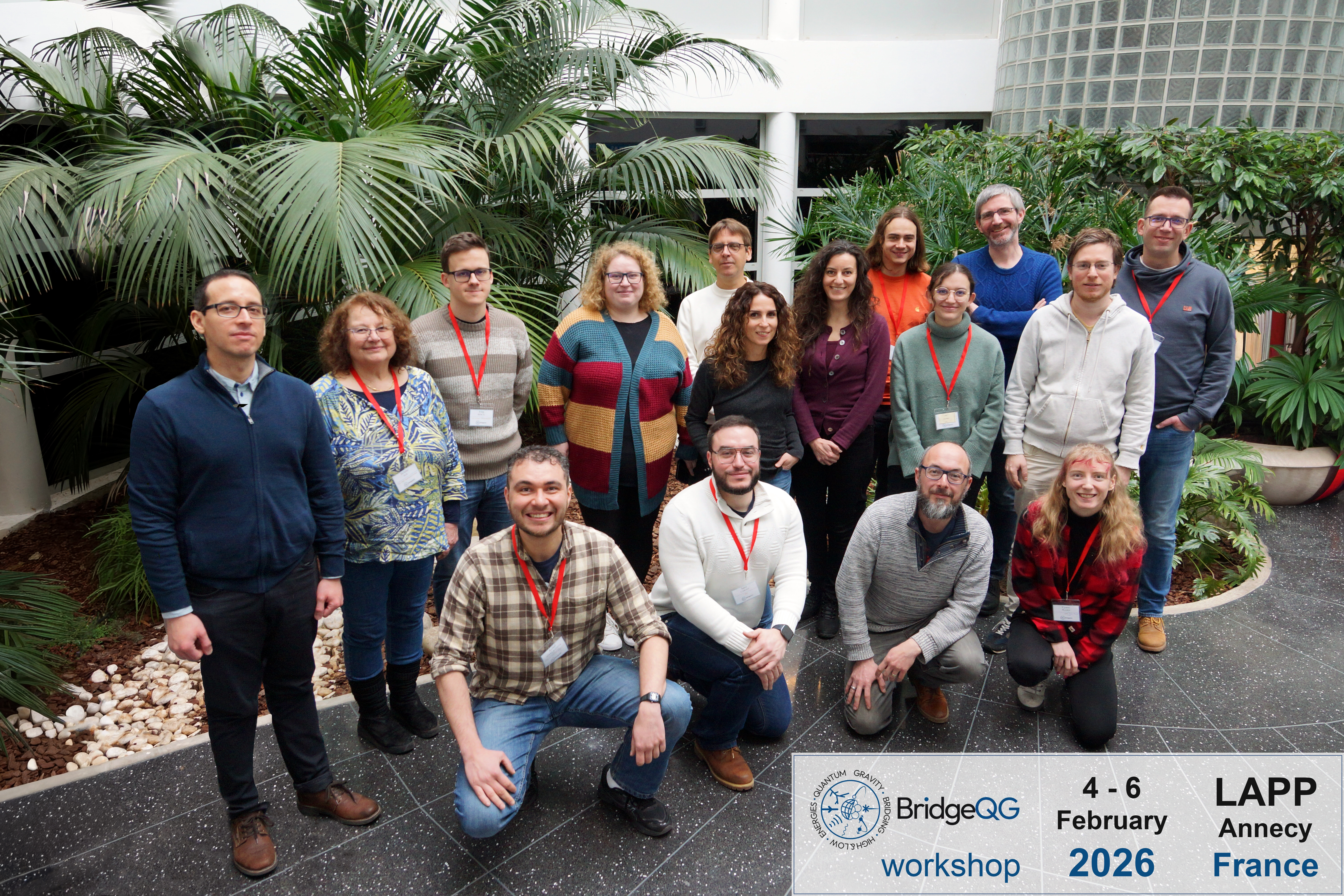
BridgeQG Workshop - Bridging High-Energy Astrophysical Modelling and Lorentz Invariance Violation Studies

Europe/Paris
Auditorium (LAPP)

Auditorium

LAPP

Description


It was already recognised in the late 1990s that signals from highly energetic and distant astrophysical sources could provide a unique opportunity to probe the quantum nature of spacetime. Such a quantum — possibly granular or even discrete — structure could alter the propagation speed of high-energy messengers (photons, cosmic rays, neutrinos...) or affect their probability of interacting with other fields or particles.

In this search for new phenomena predicted by quantum gravity (QG) models, astrophysical sources play a crucial role as sites where primary particles are created and accelerated. Correctly interpreting any observed effect therefore requires a clear distinction between QG-induced signatures and conventional astrophysical effects arising from emission or acceleration processes. In addition, standard physics at play during propagation should also be considered.

The goal of this workshop is to foster interaction between source modeling specialists and experimentalists investigating potential quantum-gravity effects, with the aim of emphasizing the scientific advances which can result from stronger cross-disciplinary collaboration.

To improve the quality of interactions and discussions, the workshop is intended to be attended in person. A Zoom connexion will be provided, but online talks won't be possible.

This workshop is partly funded by COST Action CA23130 BridgeQG.


Local Organizing Committee

Sami Caroff - LAPP Annecy, France


Scientific Organizing Committee

Julien Bolmont - Sorbonne Université, LPNHE, Paris, France

Sami Caroff - LAPP Annecy, France

Giulia Gubitosi - University of Napoli, Italy

Philip Reščić - University of Rijeka, Croatia

Tomislav Terzić - University of Rijeka, Croatia


About COST Action CA23130 BridgeQG

Recent advances in both high-energy astrophysics and high-precision table-top experiments are pushing our capability to test nature in regimes where gravity meets quantum physics. Astrophysical observations are now potentially sensitive to tiny residual effects of Planck-scale physics, while table-top experiments are reaching the precision needed to test the interplay between gravity and quantum systems at ultra-low energies. Investigations of these regimes, in particular once they are combined, will provide important clues towards the understanding of the full-fledged theory of quantum gravity. 

The main aim of the Action is to bring together scientists with a variety of complementary expertise: theorists working on quantum gravity or the interplay between gravity and quantum physics with quantum information and quantum optics tools, and experimentalists involved in astrophysical searches for quantum gravity, or investigating the effects of gravitational interactions on quantum systems. The resulting interdisciplinary collaboration will develop a common language and a shared framework which will boost investigations at the interface between high-energy quantum gravity and quantum aspects of gravity in the weak-field regime. The Action will also facilitate cross-disciplinary training and exposure of young scientists to different communities with a common goal, serving as a career accelerator. The synergy within this newly-formed community will be essential to systematically search for quantum gravity on all scales, and possibly find the first signatures of new physics.

The topics covered by BridgeQG are particularly suited for outreach. The Action will promote interest in fundamental physics among the general public and in particular school pupils.


For more information, please refer to CA23130 BridgeQG web site.


Acknowledegments

This conference is supported by COST (European Cooperation in Science and Technology). COST is a funding agency for research and innovation networks. COST Actions help connect research initiatives across Europe and enable scientists to grow their ideas by sharing them with their peers. This boosts their research, career and innovation.


Inscription
Pre-Registration
    • Welcome and registration
    • Introduction
      • 1
        Welcome and workshop presentation
        Orateur: Dr Sami Caroff (LAPP)
      • 2
        Introduction on Quantum Gravity / Lorentz Invariance Violation theory and BridgeQG cost action
        Orateur: Giulia Gubitosi (University of Napoli Federico II and INFN)
      • 3
        General talk on LIV and source intrinsic effects
        Orateur: Tomislav Terzić (University of Rijeka, Faculty of Physics)
      • 4
        Discussion
    • Coffee Break
    • State-of-the-art LIV studies with photons
      • 5
        Disentangling intrinsic source effects from LIV ones in time-lag researches with VHE gamma-rays by combining data from various observatories

        One way of detecting or constraining Lorentz invariance violation (LIV) effects is by measuring time delays in the arrival of very high-energy (VHE) photons from astrophysical sources. Suitable targets are variable, distant and highly energetic objects such as pulsars, gamma-ray bursts (GRBs), and active galactic nuclei (AGN) flares. However, a major challenge arises from intrinsic time lags due to source-specific emission processes. To improve the precision of these measurements and distinguish potential LIV-induced delays from intrinsic effects, a collaborative effort has been established among major Imaging Atmospheric Cherenkov Telescopes (IACTs): H.E.S.S., MAGIC, VERITAS, and the first Large-Sized Telescope (LST-1) of CTAO. The Gamma-ray LIV Working Group (γLIV WG) aims to combine observational data from multiple sources, enhancing the sensitivity and robustness of LIV searches. We present the first set of limits on the LIV energy scale derived from a combination of real data from IACT experiments.

        Orateurs: Cyann PLARD (LPNHE - CNRS), Cyann Plard (LAPP)
      • 6
        gLike for Lorentz invariance violation time-of-flight searches: A joint-likelihood framework and thesis case study on BL Lacertae

        This talk presents results and methods previously published in my PhD thesis. Because robust tests of Lorentz invariance violation (LIV) require the combination of multiple datasets to disentangle intrinsic source effects from propagation-induced lags, I report a joint LIV time-of-flight analysis of two BL Lacertae very-high-energy flares observed by imaging atmospheric Cherenkov telescopes: MAGIC (19–20 September 2020) and LST-1 (8–9 August 2021). For the 2020 MAGIC flare, an 88-second-binned light curve template, modeled as the sum of five asymmetric pulses and a constant background, was used to capture sub-structure relevant for time-of-flight tests. The 2021 LST-1 flare is well described by two Gaussian pulses and a constant baseline, reflecting the observed double-peak structure on 10–20 minute timescales; the light curve uses non-uniform time bins due to run sub-division. The study is implemented in the open-source maximum-likelihood framework gLike, which incorporates a dedicated unbinned LIV likelihood component and a hierarchical JointLkl combination.

        Orateur: Jelena Strišković
      • 7
        Discussion
    • 12:30
      Lunch
    • State-of-the-art LIV studies with photons
      • 8
        Phenomenology and Astrophysical Probes of Lorentz Invariance Violation and Doubly Special Relativity

        In this talk I will discuss the general phenomenological features of Lorentz Invariance Violation (LIV) and Doubly Special Relativity (DSR) frameworks. Particular attention will be given to anomalies in the flux of very-high-energy (VHE) and ultra-high-energy (UHE) gamma rays from astrophysical sources, arising from modifications of interaction thresholds induced in LIV and DSR scenarios. Such threshold anomalies can alter absorption processes on cosmic background photon fields, leading to unexpected transparency of the Universe to gamma rays and to anomalous spectral features in astrophysical sources. In this regard, I will discuss the challenges associated with identifying suitable astrophysical sources, as well as the extrapolation and modeling of their spectra into the VHE/UHE regime, which are required in order to probe LIV and DSR effects and to explore the parameter space of the new physics scales introduced by these scenarios. Finally, I will discuss the prospects offered by the future Southern Wide-field Gamma-ray Observatory (SWGO), highlighting its potential sensitivity to these effects through observations of galactic and extragalactic sources in the southern sky.

        Orateur: Filip Reščić (University of Rijeka)
      • 9
        Constraints on LIV effects from EBL absorption using broadband blazar modeling - Online

        Lorentz Invariance Violation (LIV) effects are predicted in some theories of Quantum Gravity (QG) and would manifest as energy-dependent modifications to particle kinematics. Such effects can alter the threshold of the electron–positron pair production process, leading to observable deviations in the absorption of very-high-energy photons by the Extragalactic Background Light (EBL). We exploit this effect to search for LIV signatures in the TeV spectral features of blazars. We have developed a spectral analysis framework based on broadband modeling of the source emission using a classical synchrotron self-Compton (SSC) scenario, combined with an LIV-modified EBL absorption model. In this talk, we introduce and discuss the spectral method for LIV searches and present preliminary results obtained from broadband multiwavelength observations of BL Lac during its flaring activity in 2022.

        Orateur: Alberto Rosales De Leon (Observatoire de Paris)
      • 10
        Discussion
    • Coffee Break
    • GRB modelling
      • 11
        Gamma-ray bursts as tools to study Lorentz invariance violation

        Gamma-ray bursts (GRB) are cosmoligocal sources with average redshift around 2, emitting radiation over the entire electromagnetic spectrum. Two different sites are responsible for the radiated emission: one internal to the relativistic jet (responsible for the prompt, higly-variable soft gamma-ray radiation detected over timescales of ms to tens of seconds) and one external, originated from the shock driven by the front of the jet into the surrounding medium. The latter one, called afterglow radiation, is detected from the radio to the gamma-ray domain. Since 2019 we know that afterglow radiation can extend to the very-high energy domain, with photons detected by Cherenkov Telescopes in the range 50 GeV-10 TeV. These energies, coupled with the large distances of these sources, make GRBs a potentially powerful tool for Lorentz Invariance Violation (LIV) studies. In this contribution, I will review the physics and the modeling of afterglow emission, with a particular focus on very-high energy radiation and applications to LIV studies.

        Orateur: Lara Nava (INAF)
      • 12
        To Be Confirmed - Online
        Orateur: Prof. Frédéric DAIGNE (Institut d'Astrophysique de Paris - Sorbonne Université)
      • 13
        Discussion
    • AGN modelling and observation
      • 14
        Radiative models for rapid blazar flares - a quick overview

        When using the light curves of rapid blazar flares for searches of propagation effects, it is important to understand the
        intrinsic temporal and spectral signatures introduced by the underlying particle acceleration and emission processes
        producing those flares. Unfortunately, the nature of these processes is not well known. Most scenarios place the emission
        region inside the relativistic jet, but the black hole magnetosphere might be an alternative site to explain the most rapid flares.
        Particle acceleration can occur in shocks or turbulences, but might also be due to magnetic reconnection, depending on the
        physical conditions of the emission region. Possibly there is more than a single process at play behind the variety of observed
        flare shapes and their different time scales.
        I will provide a short overview of the main types of models that try to explain rapid flare emission in blazars, with a focus on the
        predictions of light-curve shapes and intrinsic time delays.

        Orateur: Andreas Zech (LUTH - Observatoire de Paris)
      • 15
        Developments and challenges in neutrino source modeling

        The IceCube South Pole Observatory detects cosmic neutrinos up to a few PeV, and the KM3NeT experiment in the Mediterranean Sea has recently detected the first event above 100 PeV, inaugurating the era of ultra-high-energy neutrino astronomy. Active black holes, in particular blazar jets, are among the most promising candidate sources. In this talk, I summarize recent developments in leptohadronic blazar modeling. I discuss predictions for the electromagnetic signatures of neutrino production, current degeneracies and challenges faced by models, and the crucial role of future multi-messenger facilities.

        Orateur: Xavier Rodrigues (APC)
      • 16
        Discussion
    • Coffee Break
    • AGN modelling and observation
      • 17
        Investigating AGN Variability with the Cherenkov Telescope Array
        Orateur: Guillaume Grolleron
      • 18
        Variable extragalactic sources with the LST(s): Status and prospects
        Orateur: David Sanchez (LAPP/IN2P3)
      • 19
        Discussion
    • 12:30
      Lunch
    • Neutrinos
      • 20
        Quantum gravity with high-energy cosmic neutrinos

        High-energy cosmic neutrinos probe fundamental physics at scales of energy and distance otherwise unreachable, where new physics may manifest. Since the discovery of TeV-PeV cosmic neutrinos in 2013, we have explored this progressively more broadly and more precisely, thanks to a growing number of detected neutrinos and improvements in reconstruction and analysis techniques. Quantum gravity has motivated several of these tests, including changes in the neutrino energy spectrum, flavor mixing, arrival directions, and arrival times, as expected from Lorentz-invariance violation of quantum decoherence. I will survey these efforts, which have led to stringent tests of new physics. I will also touch upon new opportunities made possible by the recent discovery of an ultra-high-energy neutrino, with about 200 PeV, by KM3NeT---with a warning. Looking ahead, I will show two prospects for progress in the next decade, driven by new, upcoming neutrino telescopes: a boost in the detection rate of TeV-PeV neutrinos and the possible detection of more ultra-high-energy neutrinos.

        Orateur: Mauricio Bustamante Ramirez (Niels Bohr Institute, University of Copenhagen)
    • Multimessenger and Multiwavelength
      • 21
        Unknowns in multimessenger high-energy astrophysics and their influence in the search for Lorentz invariance violation

        Searching for new phenomena predicted by quantum-gravity (QG) effects in high-energy astrophysics implies to be able to distinguish the signatures related to standard physics in sources and propagation from the ones coming from pure QG. In this contribution I will focus on the interpretation of ultra-high-energy cosmic ray (UHECR) data in terms of astrophysical scenarios for the fluxes of cosmic rays and secondary particles at the escape from candidate source environments, with some connections to in-source interactions. In addition, I will discuss how QG effects, such as modified processes due to Lorentz invariance violation (LIV), might alter such an interpretation. I will also show how the uncertainties in the determination of some characteristics of UHECRs can influence the ability to constraint LIV, as for the expectations for the secondary messengers.

        Orateur: DENISE BONCIOLI (University of L'Aquila and INFN-LNGS)
      • 22
        Discussion
    • Coffee Break
    • Multimessenger and Multiwavelength
      • 23
        Accelerating Multiwavelength and Multimessenger Data Modeling with Neural-Network Surrogates

        Multiwavelength and multimessenger observations, combining data across the electromagnetic spectrum with high-energy neutrinos, provide a uniquely powerful probe of the physical processes at work in the relativistic jets of blazars. Recent campaigns and coincident neutrino detections have reinforced the role of blazars as prime laboratories for studying particle acceleration and radiation in extreme environments, while simultaneously highlighting the need for modeling frameworks that can consistently interpret these rich and heterogeneous datasets. However, physically motivated leptonic, hadronic, and hybrid radiative models remain computationally demanding, making comprehensive parameter-space exploration and statistically robust fitting of multiwavelength and multimessenger data prohibitively expensive. In this presentation, I introduce a novel approach based on convolutional neural networks (CNNs) which accelerates broadband blazar emission modeling. The CNN is trained on synthetic spectra produced by the SOPRANO numerical code and accurately reproduces the radiative output from electrons, protons, and secondary particles across the full electromagnetic range, while preserving the physical structure of the underlying model. This approach effectively transforms computationally intensive radiative calculations into a fast surrogate model suitable for large-scale parameter scans and rigorous statistical inference. I demonstrate the performance and scientific impact of this method through joint modeling of multiwavelength and multimessenger spectral energy distributions of several blazars, showing that it enables efficient and self-consistent constraints on the physical conditions in the jet and a coherent interpretation of both photon and neutrino emission.

        Orateur: Narek Sahakyan (ICRANet-Armenia)
      • 24
        Astrophysical Searches for Quantum Gravity: what multi-messenger observations can (and cannot) tell us

        What if there are already signatures of quantum gravity (QG) in the existing high-energy multi-messenger data -- would we be able to know that?
        In this talk, I discuss the complexities inherent in separating new physics from conventional astrophysical processes. Disentangling these two signals is not merely a technical challenge; it is an epistemic one. I argue that we are currently limited by what we can plausibly model, and entertain the possibility that some QG signatures may remain observationally undecidable even if they already exist. Finally, I discuss how a genuinely multi-messenger approach could help reduce degeneracies, ultimately enabling reliable constraints of QG phenomena.

        Orateurs: Rafael Alves Batista, Rafael Alves Batista (Sorbonne Université, Institut d'Astrophysique de Paris)
      • 25
        Discussion
    • Disentangling LIV timelag from astrophysical effects
      • 26
        Distinguish timelags due to LIV effects from timelags induced by intrinsic effects
        Orateur: HELENE SOL (LUTH)
      • 27
        Tackling distinction between LIV timelag and intrinsic effects with minimalistic methods
        Orateur: Dr Sami Caroff (LAPP)
    • Social Dinner
    • Discussion / Buffer
    • What next ? Discussion on collaborative work, opportunities and funding
      • 28
        Collaboration / Funding / discussion
        Orateur: Dr Julien Bolmont (LPNHE - SU/CNRS-IN2P3)
    • Coffee Break
    • What next ? Discussion on collaborative work, opportunities and funding
    • 12:30
      Lunch
    • Meeting Room 2 - working area
    • Meeting room 1 - Gamma-LIV Working Group Meeting