Neuvième Assemblée Générale du GdR Ondes Gravitationnelles
Amphi Jean Jaurès (entrée au 29 rue d'Ulm)
LPENS
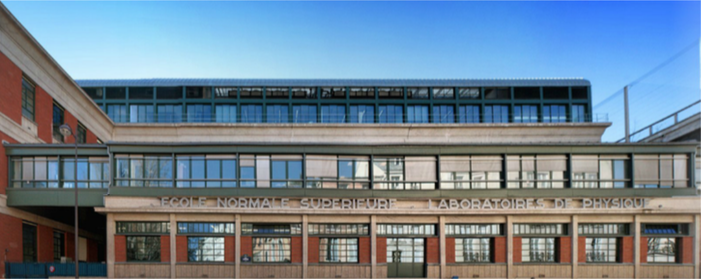
Le GdR Ondes Gravitationnelles (http://gdrgw.in2p3.fr/) a été crée en 2017 avec le but de rassembler la communauté scientifique intéressée par l’exploration de l’Univers avec les ondes gravitationnelles, et de lui fournir des occasions de rencontres et de discussions communes.
La neuvième assemblée générale du GdR Ondes Gravitationnelles se tiendra en présence à l'ENS. Elle couvrira les thèmes d’intérêt du GdR, représentés par ses Groupes de Travail.
L'inscription à cette réunion est obligatoire avant le 12 septembre 2025. Il faut, au préalable, devenir membre du GdR en s'inscrivant sur le site http://gdrgw.in2p3.fr/ si vous ne l'êtes pas déjà.
La date limite pour envoyer une contribution est le 12 septembre 2025.

-
-
10:30
Coffee welcome Amphi Jean Jaurès (entrée au 29 rue d'Ulm)
Amphi Jean Jaurès (entrée au 29 rue d'Ulm)
LPENS
Laboratoire de Physique de l'ENS -
Invited talk: Reconciling Pulsar Timing Arrays Observations with Supermassive Black Hole Binary Predictions Amphi Jean Jaurès (entrée au 29 rue d'Ulm)
Amphi Jean Jaurès (entrée au 29 rue d'Ulm)
LPENS
Laboratoire de Physique de l'ENSIn June 2023, the Pulsar Timing Array (PTA) collaborations reported the first strong evidence of the presence of a stochastic gravitational wave background (GWB) in the nanohertz band. Assuming that the common stochastic signal induced by gravitational waves is isotropic, stationary, and unpolarized, the collaborations were able to constrain its power spectral density. The obtained spectrum is in tension with theoretical predictions from the local population of supermassive black hole binaries: the power spectrum is not as red as expected, and its amplitude at 1/year is too high.
In this talk, I will present some caveats regarding PTA data analysis methods that could lead to such tensions. We will discuss the impact of the spectral inference methods used by PTAs and show the potential bias they can induce in the interpretation of their data. We will then present the impact of the intrinsic pulsar noise modeling on the GWB spectral inference. In particular, we find that the solar wind modeling used in the EPTA data is insufficient. The inclusion of a more accurate solar wind model leads to a steeper and weaker (at 1/year) GWB power spectrum.
Président de session: Hippolyte QUELQUEJAY -
FORMES D'ONDES Amphi Jean Jaurès (entrée au 29 rue d'Ulm)
Amphi Jean Jaurès (entrée au 29 rue d'Ulm)
LPENS
Laboratoire de Physique de l'ENS-
1
Enjeux du group de travail [5]
-
2
Tom Colin: Dynamics of Spinning, Eccentric Binary Black Holes at Second Post-Newtonian Order [9+2]Orateur: Tom Colin (LUX)
-
3
David Trestini: Schott terms in the binding energy at fourth post-Newtonian order [9+2]Orateur: David Trestini (University of Southampton)
-
4
Eve Dones: Post-Newtonian Tidal Effects in the Gravitational Waveform from Binary Inspirals in Scalar-Tensor Theories [9+2]Orateur: Eve Dones (LUTH - Observatoire de Paris)
-
5
Etienne Ligout: Innermost stable circular orbit of arbitrary-mass compact binaries at 4PN [9+2]Orateur: Etienne Ligout (APC)
-
6
Emeric Seraille: Gravitational radiation reaction for compact binary systems at the fourth-and-a-half PN order in harmonic coordinates [9+2]Orateur: Emeric Seraille (LPENS)
-
1
-
Déjeuner
-
ÉTOILES A NEUTRONS, SUPERNOVÆ ET SYNTHÈSES DES ÉLÉMENTS LOURDS Amphi Jean Jaurès (entrée au 29 rue d'Ulm)
Amphi Jean Jaurès (entrée au 29 rue d'Ulm)
LPENS
Laboratoire de Physique de l'ENS- 7
-
8
Gabriele Montefusco: An ”almost-causal” Meta-Model for Neutron Star matter [10+3]Orateur: Gabriele MONTEFUSCO (CNRS - LPC Caen)
-
9
Lami Suleiman: Equation of state and nuclear parameter inference with gravitational wave detections of binary neutron star mergersOrateur: Lami Suleiman (Deutsches Elektronen Synchrotron)
-
10
Santiago Jaraba: Numerical simulations of oscillations in differentially rotating neutron starsOrateur: Dr Santiago Jaraba (Observatoire astronomique de Strasbourg - CNRS)
-
11
Matteo Bugli: The impact of rotation and nuclear equations of state on the multi-messenger emission from core-collapse supernovaeOrateur: Matteo Bugli (Institut d'astrophysique de Paris - CNRS)
-
Invited talk: On the internal constitution of neutron stars and their equation of state Amphi Jean Jaurès (entrée au 29 rue d'Ulm)
Amphi Jean Jaurès (entrée au 29 rue d'Ulm)
LPENS
Laboratoire de Physique de l'ENSFormed in the aftermath of gravitational core-collapse supernova explosions, neutron stars are the most compact observed stars. Their average density exceeds that found inside the heaviest atomic nuclei. Neutron stars are also endowed with the highest magnetic fields known, which can reach millions of billion times that of the Earth. According to our current understanding, a neutron star is stratified into distinct layers. The surface is probably covered by a metallic ocean. The solid layers beneath consist of a crystal lattice of pressure-ionized atoms embedded in a highly degenerate relativistic electron gas. With increasing density, nuclei become progressively more neutron rich until neutrons start to drip out of nuclei thus delimiting the boundary between the outer and inner regions of the crust, where neutron-proton clusters are immersed in a neutron liquid. At about half the density of heavy nuclei, the crust dissolves into a homogeneous liquid mixture of nucleons and leptons. Over the past years, we have developed a series of unified equations of state of dense matter in neutron stars, available on the European CompOSE database. Based on the nuclear energy-density functional theory, these equations of state provide a thermodynamically consistent treatment of all regions of the star and were calculated using functionals that were precision fitted to experimental and theoretical nuclear data. These equations of state were specifically developed to assess the role of nuclear uncertainties on neutron-star properties. Predictions will be compared to constraints inferred from the detection of the gravitational-wave signal GW170817 from a binary neutron-star merger and from observations of the electromagnetic counterparts. Constraints inferred from other observations will be also discussed.
Président de session: Nicolas Chamel (Université Libre de Bruxelles) -
Coffee break Amphi Jean Jaurès (entrée au 29 rue d'Ulm)
Amphi Jean Jaurès (entrée au 29 rue d'Ulm)
LPENS
Laboratoire de Physique de l'ENS -
PRÉDICTION ET SUIVI DES SIGNAUX MULTI-MESSAGER (1) Amphi Jean Jaurès (entrée au 29 rue d'Ulm)
Amphi Jean Jaurès (entrée au 29 rue d'Ulm)
LPENS
Laboratoire de Physique de l'ENS-
12
Enjeux du groupe de travail [5]
- 13
-
14
Susanna Vergani: Multi-messenger observations in the ET era [10+3]Orateur: Susanna Diana VERGANI (CNRS-Observatoire de Paris)
-
12
-
COSMOLOGIE Amphi Jean Jaurès (entrée au 29 rue d'Ulm)
Amphi Jean Jaurès (entrée au 29 rue d'Ulm)
LPENS
Laboratoire de Physique de l'ENS-
15
Enjeux du groupe de travail [5]
-
16
Benoit Revenu: Cosmological contraints obtained with the fourth gravitational wave transients catalog (GWTC-4.0) of the LVK collaboration [15+5]Orateur: Benoît Revenu (subatech)
-
17
Tom Bertheas: Towards a few % measurement of H0 with the current network of GW detectors without using EM information [10+2]Orateur: Tom Bertheas (L2IT, LPENS)
-
18
Alessandro Pedrotti: Cosmology with the Angular Cross-Correlation of Contenu Galaxies and GWs [10+2]Orateur: Alessandro Pedrotti (CPT)
-
19
Syksy Räsänen: The effect of matter discreteness on gravitational wave propagation [10+2]Orateur: Syksy Räsänen (University of Helsinki)
-
20
Arthur Poisson: A look through the dark ages of cosmological inflation via the scalar-induced Gravitational wave background [10+2]Orateur: Arthur Poisson (IAP)
-
15
-
Cocktail
-
10:30
-
-
TESTS DE LA RELATIVITÉ GÉNÉRALE ET THÉORIES ALTERNATIVES Amphi Jean Jaurès (entrée au 29 rue d'Ulm)
Amphi Jean Jaurès (entrée au 29 rue d'Ulm)
LPENS
Laboratoire de Physique de l'ENS-
21
enjeux du groupe de travail [5]
-
22
Felipe Barbosa: Forecasting general relativity constraints with 3G detectors [9+2]Orateur: Felipe Barbosa (Federal University of Espirito Santo)
-
23
Andrea Begnoni: Beyond GR tests with Einstein Telescope [9+2]Orateur: Andrea Begnoni (University of Padova, INFN Padova)
-
24
Charles Dalang: Multi-messenger lensing time delay as a probe of the graviton mass [9+2]Orateur: Charles Dalang (LPENS)
-
25
Aaron Held: Numerical relativity waveforms in effective field theories of gravity [9+2]Orateur: Aaron Held (École Normale Supérieure)
-
26
Iosif Bena: Positive spin-induced quadrupole moment [9+2]Orateur: Iosif Bena (IPhT, CEA-Saclay)
-
21
-
Invited talk: Updates from the fourth release of the Gravitational Wave Transient Catalog (GWTC-4) and latest results from the search for an Isotropic Gravitational-Wave Background from the first part of LIGO, Virgo, and KAGRA's fourth Observing Run (O4a).
In this talk, I present the latest results from the fourth release of the Gravitational Wave Transient Catalog (GWTC-4) and the search for an isotropic Gravitational-Wave Background (GWB) using data from the first part of LIGO, Virgo, and KAGRA’s fourth observing run (O4a). GWTC-4 includes 128 new compact binary coalescence (CBC) candidates, consistent with binary black holes and binary neutron stars, bringing the total to 218, including several detections with SNR > 30. Regarding the GWB, although no evidence for a signal is found, we set improved constraints on several theoretical models. For compact binaries with a 2/3 power-law spectrum, we improve limits on the fractional energy density by a factor of 1.7; for scale-invariant backgrounds, sensitivity improves by a factor of 2.1. New bounds are also placed on non-standard polarization modes. Combining these limits with GWTC-4 population models, constraints remain above the predicted merger background. Using GWTC-4 inference and standard modeling assumptions, we estimate that the total CBC background could be detectable with A+ sensitivity.
Président de session: Alba Romero-Rodríguez (Laboratoire d'Annecy de Physique de Particules (LAPP)) -
Coffee break Amphi Jean Jaurès (entrée au 29 rue d'Ulm)
Amphi Jean Jaurès (entrée au 29 rue d'Ulm)
LPENS
Laboratoire de Physique de l'ENS -
DEVELOPPEMENT DES DETECTEURS Amphi Jean Jaurès (entrée au 29 rue d'Ulm)
Amphi Jean Jaurès (entrée au 29 rue d'Ulm)
LPENS
Laboratoire de Physique de l'ENS-
27
enjeux du groupe de travail [5]
-
28
Stephanie Grabielle: Parametric Instability Mitigation in Contenu gravitational-wave detectors [8+2]Orateur: Stéphanie Grabielle (Laboratoire ARTEMIS)
-
29
Yiming Meng: MIGA II: Gravitational Wave Testbed [8+2]Orateur: Yiming MENG (Institut d'Optique Graduate School)
-
30
Clement Jacquet: Simulation des méthodes de caractérisation du détecteur d’ondes gravitationnelles Virgo [8+2]Orateur: Clément JACQUET (L2I Toulouse, Université de Toulouse, CNRS/IN2P3)
-
31
Patrice Verdier: The project Einstein Telescope [20+15]Orateur: M. Patrice Verdier (IP2I Lyon - IN2P3)
-
27
-
DISCUSSION et table ronde sur Einstein Telescope Amphi Jean Jaurès (entrée au 29 rue d'Ulm)
Amphi Jean Jaurès (entrée au 29 rue d'Ulm)
LPENS
Laboratoire de Physique de l'ENSPanelists: Angélique Lartaux, Michele Mancarella, Nicola Tamanini, Susanna Vergani
Président de session: Matteo BARSUGLIA (AstroParticule et Cosmologie) -
Déjeuner ( )
-
PRÉDICTION ET SUIVI DES SIGNAUX MULTI-MESSAGER (2) Amphi Jean Jaurès (entrée au 29 rue d'Ulm)
Amphi Jean Jaurès (entrée au 29 rue d'Ulm)
LPENS
Laboratoire de Physique de l'ENS-
32
Pierre-Alexandre Duverne : Sub-threshold searches for coincidences between gravitational waves and neutrino detected with neutrino telescopes in the depths of the Mediterranean Sea [10+3]Orateur: Pierre-Alexandre Duverne (Astroparticules et Cosmologie)
-
33
Ines Bentara: Prospective Study of Virgo’s Impact in Sky Localisation of Gravitational Wave Events within the LVK Network for O5 [10+3]Orateur: Inès Bentara
-
32
-
POPULATION DES SOURCES Amphi Jean Jaurès (entrée au 29 rue d'Ulm)
Amphi Jean Jaurès (entrée au 29 rue d'Ulm)
LPENS
Laboratoire de Physique de l'ENS-
34
enjeux du groupe de travail [5]
-
35
Viola de Renzis: Which is which? Identification of the two compact objects in gravitational-wave binaries [10+3]Orateur: Viola De Renzis (University of Milano-Bicocca)
-
36
Alexandre Toubiana : Methods for population studies on LVK data [10+3]Orateur: Alexandre Toubiana (Max Planck Institute for Gravitational Physics)
-
34
-
Invited talk: LISA : A spaceborne observatory for detecting gravitational waves Amphi Jean Jaurès (entrée au 29 rue d'Ulm)
Amphi Jean Jaurès (entrée au 29 rue d'Ulm)
LPENS
Laboratoire de Physique de l'ENSThe LISA project of gravitational waves detection has been selected in January 2024 by the European Space Agency as the third ‘Large’ mission of the ‘Cosmic Vision’ program, with an expected launch date in 2035. This mission relies on the capability to measure, using laser interferometry, the distance fluctuations between satellites 2.5 Mkm apart, with a picometer accuracy on seconds to hours timescales.
LISA is the product of an international development effort, France being part of the European collaboration providing the instrument. In this context, the CNES and about fifteen French laboratories are contributing to the validation of the scientific performance of the instrument prior to flight and are currently developing the required high-precision optical metrology benches and measurement systems.
In this presentation we shall give an overview of the LISA instrument, its technical challenges and development schedule. We will focus on the validation strategy on ground, especially the demonstration of the interferometric performance in the mHz to Hz regime.Président de session: Hubert Halloin (APC / Université Paris Cité) -
Coffee break Amphi Jean Jaurès (entrée au 29 rue d'Ulm)
Amphi Jean Jaurès (entrée au 29 rue d'Ulm)
LPENS
Laboratoire de Physique de l'ENS -
MÉTHODES D’ANALYSE DES DONNÉES Amphi Jean Jaurès (entrée au 29 rue d'Ulm)
Amphi Jean Jaurès (entrée au 29 rue d'Ulm)
LPENS
Laboratoire de Physique de l'ENS-
37
enjeux du groupe de travail [5]
-
38
Hugo Einsle : Gravitational-wave background detection using machine learning [12+3]Orateur: Hugo Einsle (Université Côte d'Azur)
-
39
Alexis Boudon: Contraintes sur l’EOS à partir d’un vaste ensemble de fusions BNS simulées et accélérées par ROQ avec le réseau LVK [12+3]Orateur: Alexis Boudon (IP2I - IN2P3, CNRS)
-
37
-