Choisissez le fuseau horaire
Le fuseau horaire de votre profil:

The next biannual meeting of the Rubin-LSST France community will be held 18-20 May 2026, at LAPP in Annecy.
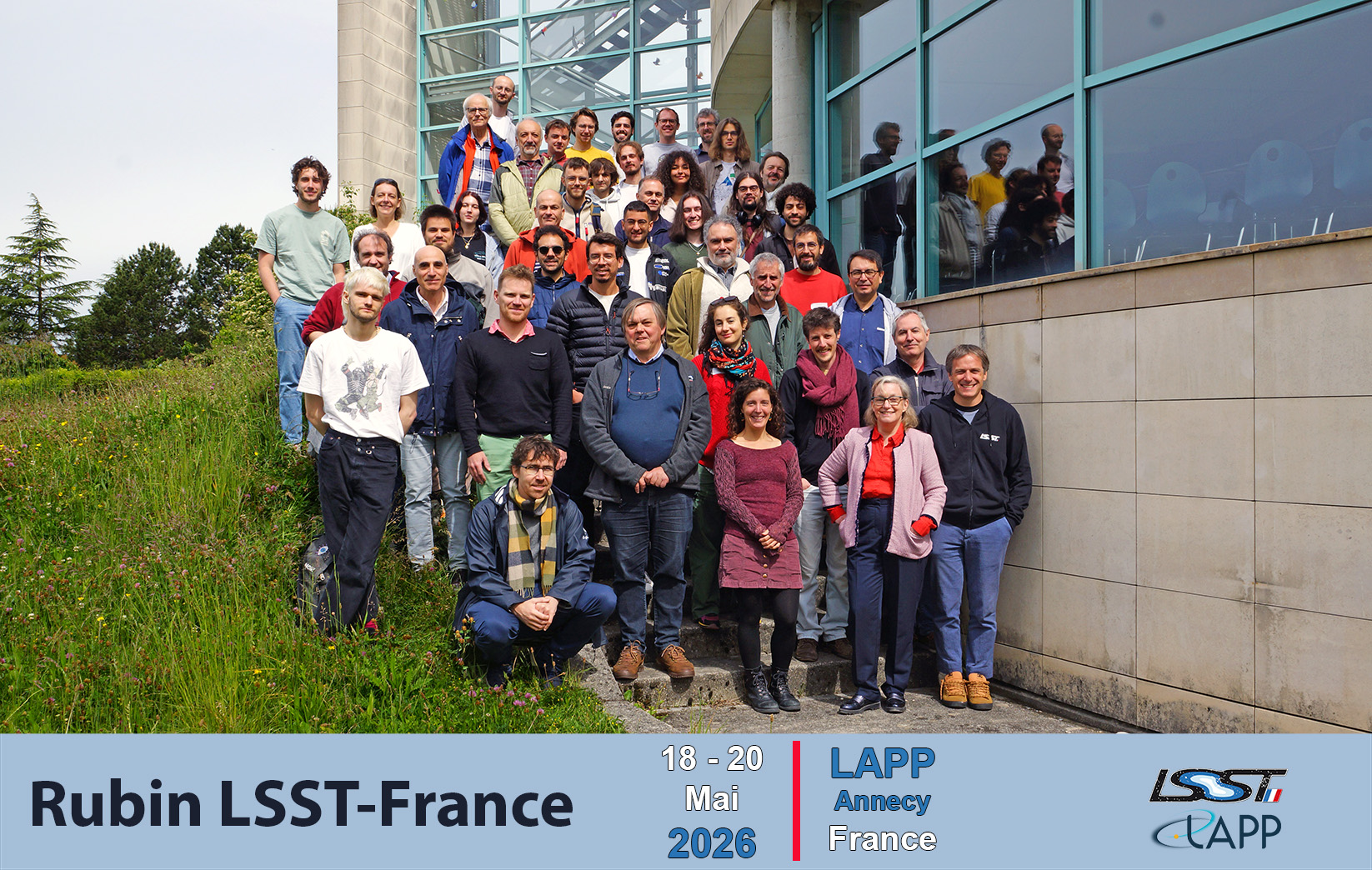
The agendas of the most recent editions of this meeting can be found online:
In this presentation I want to share a feedback on spending a year at the observatory for the integration of the filter exchange system.
I will talk about the local environment, the day-to-day job, the hard work and the joyful moments and the overall success of this integration.
Probably a bar booked for the Early Careers :)
The Vera C. Rubin Observatory’s LSST requires accurate photometric calibration to meet its science goals, particularly for cosmological measurements using Type Ia supernovae. The Collimated Beam Projector (CBP) has been developed to support this effort. By projecting an array of collimated beams onto the telescope pupil, the CBP enables direct measurements of the telescope’s photometric response and facilitates precise characterization of individual optical components, including filters. In addition to telescope response measurements without a filter, the CBP has proven effective for detailed filter throughput characterization. A critical aspect of this effort is the accurate mapping of filter bandpass edges, which can vary by several nanometers as a function of angle of incidence across the large LSSTCam field of view. We report initial measurements of the instrumental telescope response and of the spatially dependent wavelength shifts for the LSSTCam filters using the CBP. These early results demonstrate the capability of the CBP to deliver the high-precision calibration products required to meet LSST photometric performance goals and establish a foundation for ongoing system throughput monitoring.
StarDICE is a metrology experiment with the goal of establishing
precise flux references for the Vera Rubin Observatory. The success of
this enterprise is expected to boost the constraining power of the
supernovae survey (as measured by the DETF FoM) by a factor 2. To this
effect, a 16 inches robotic telescope installed at the Observatoire de
Haute Provence is conducting a long duration survey of the apparent
flux of the 3 primary spectrophotometric standard stars of the CALSPEC
library in the 6 $ugrizy$ bands. This effort is coupled with an
instrumental R&D to perform an absolute calibration of the
transmission of this instrument, completing the link between the
astrophical flux scale and the laboratory definition of the optical
watt maintained by the NIST.
In this contribution, we propose to review the current status of the
experiment, in light of recent progress on the front of the in-situ
absolute calibration of the telescope.
The Simonyi telescope is a complex optical system that uses a sophisticated real time control system to deliver optimal quality images.
I will explain how the mirrors, rotator, hexapods, etc. are controlled and how the telemetry data are used to monitor and improve the performances of the telescope.
I will not enter into the details of the Active Optics system but will rather focus on the main components of the optics and associated mechanics.
The results of a study related to the impact of atmospheric transmission (parameters: airmass, aerosol, ozone, precipitable water vapor) on SNe Ia cosmology using recent LSST simulations of Deep Rolling scenarios will be presented.
Type Ia Supernovae (SNe Ia) are at the center of current tensions on H₀ and w, the parameters characterising the expansion of the Universe. Controlling survey cross-calibration, selection functions, and SNe Ia variability is essential to avoid systematic biases in cosmological inference. Realistic simulations are key to addressing these systematics, but existing tools remain limited in their ability to capture the full complexity of SNe Ia populations and survey-specific selection effects.
I will present the ongoing developments of skysurvey, extending the framework to incorporate SNe Ia variability, population evolution with redshift, and calibration systematics. These developments, carried out in preparation for higher-redshift surveys such as the LSST survey, aim to produce next-generation simulations that can be used to assess and correct systematic biases in cosmological parameter inference.
Systematic uncertainties associated to calibration, selection functions and astrophysical effects are dominating the error budget of SNe Ia cosmology. Correction methods applied to account for these systematics, and especially for the complex combination of selection functions and astrophysical variability, are questionable, particularly given the current H0 and Λ tensions for which SNe Ia data are central.
Recently, the ZTF survey has produced a volume-limited sample of more than a thousand SNe Ia, allowing to directly probe the distribution of SNe Ia parameters without being affected by selection effects. However, extending the cosmological analysis to higher redshifts, leveraging the full ZTF DR2 dataset, and combining it with the future LSST data, requires a robust treatment of selection effects.
Using datasets realistically produced using skysurvey, we train a neural network to infer the simulation input parameters. This novel inference method, called SBI, is a promising avenue to solve the complex problem of cosmological inference with SNe Ia data, and thus accurately derive H0, w0 and wa.
Strongly lensed supernovae (SNe) enable independent measurements of the Hubble constant (H₀) through time-delay cosmography, offering a critical test of the current H₀ tension. Their rapid follow-up also enables unique diagnostics of early explosion physics and progenitor properties. In this talk, I will present forecasts for (a) measurements of the Hubble constant and (b) constraints on SN progenitors achievable with forthcoming samples of strongly lensed SNe from Rubin-LSST. I will then describe our newly developed deep-learning approaches to search for lensed SNe in LSST with minimal contamination rates, including flexible architectures designed to classify multi-band image time series of variable length.
As a pathfinder, I will present the analysis and modeling of SN 2025wny (SN Winny) at zₛ = 2.008, the first confirmed galaxy-scale strongly lensed superluminous SN detected with ZTF in mid-2025. Spectroscopic follow-up of SN Winny reveals a blue continuum and weak UV features consistent with a hot Type I SLSN. Moreover, its long time delays make SN Winny well suited for independent measurements of the Hubble constant. I will present the follow-up campaign, characterization, and modeling of this exciting system and show how it paves the way for future analyses of larger samples selected by Rubin-LSST.
Are the standard approximations used in gravitational lensing still adequate in the era of precision cosmology? If not, how can we move beyond them?
As cosmological tensions sharpen, a new generation of surveys such as Euclid and LSST is set to deliver an unprecedented volume of data, with billions of galaxies analyzed through increasingly sophisticated pipelines, including machine-learning techniques. Despite the technical progress, the theoretical framework used to interpret weak lensing observations still relies largely on approximations that have remained essentially unchanged for several decades. In this talk, we revisit the relativistic foundations of gravitational lensing and explore a framework that moves beyond these standard assumptions and towards the precision needs of the next generation of cosmological surveys.
In particular, we introduce EXCALIBUR, a numerical approach being developed and designed to model light propagation in ΛCDM cosmological settings through the direct integration of null geodesics in first-order perturbed FLRW spacetimes. This method enables the extraction of fully relativistic lightcones for a given cosmological background and provides a unified description and extraction of weak and strong lensing signals within a single pipeline. It relies on evaluating relevant tensor quantities from which the full Jacobi mapping is reconstructed without relying on perturbative expansions. This framework gives direct access to lensing observables such as convergence and shear, while naturally extending to higher-order distortions beyond the standard weak-lensing formalism.
We will discuss how this approach compares to current weak lensing methods, validating our study on known analytical halo models before dwelling into different cases of mass shapes and profiles. In particular, we are interested in effects that arise when relaxing usual hypothesis, such as the Born and thin lens approximations. Generating mock observables this way allows us to naturally capture post-Born and relativistic effects (e.g. lens-lens couplings, light beam rotations, higher-order distortions, redshift and angular distances effects), and to assess potential systematics in shear measurements and cosmological parameter inferences.
We present a framework for generating lightcone simulations optimized for Stage-IV cosmic shear analyses using Higher-Order Statistics (HOS). We revisit and improve key design choices from previous simulation campaigns, assessing their impact under survey conditions representative of 10 years of LSST observations. We show that uniform spacing in scale factor provides better accuracy than standard redshift- or distance-based schemes, and that high mass resolution is essential for robustly modeling HOS. In particular, simulations with $2048^3$ particles accurately reproduce all statistics while allowing a reduced number of lightcone shells with negligible loss of precision, significantly lowering computational costs. We also demonstrate that particle densities at high redshift can be substantially downsampled without affecting observables. These results provide practical guidance for future forward-modeling and emulator analyses of Stage-IV weak-lensing data.
Surveys like the Vera C. Rubin Observatory's LSST, ESA's Euclid, and NASA's Roman Space Telescope aim to explore dark energy through measurements of weak gravitational lensing and large-scale structure. However, blending, where faint overlapping galaxy sources are misidentified, introduces substantial errors in galaxy shape and flux measurements, especially for deep, ground-based surveys like LSST. This effect poses a major challenge to accurate WL measurements.
In this talk, I will present my first results when characterizing blending in LSST commissioning (Data Preview 1) and show the importance of a new metric developped in the context of Manon Ramel's PhD, the blending entropy, for these analyses. I will then talk about my other project which aims to quantify the impact of blending on the 3x2pt cosmological analysis using CosmoDC2.
PhD Advisor : Cyrille Doux
We present a per-galaxy weak lensing likelihood built directly on raw ellipticities and photometric P(z), modeling the unlensed ellipticity distribution while jointly fitting cluster mass and center via tangential and cross shear, with results from HSC and LSST Data Preview 1.
In the alerts received by the Fink broker, we identified a number of diaObjects associated with stable Gaia stars that nevertheless triggered multiple detections in the Rubin alert pipeline within the Deep Drilling Fields.
After cross-matching these objects with the Gaia catalog of stable stars with magnitude G < 20.5 mag, we investigate a sample of eight such stars using Fink cutouts and prompt-processing difference images. The goal is to understand the artifacts responsible for these spurious alert triggers.
Blazars are among the most violent non-thermal sources in the Universe, exhibiting dramatic variability across the electromagnetic spectrum. Yet, a key question remains: how tightly coupled are their optical and $\gamma$-ray emissions, and what does this reveal about the physical processes powering relativistic jets?
In this work, we present a multi-year study of optical–$\gamma$-ray correlations in blazars using data from the Fermi Large Area Telescope (LAT) and the Zwicky Transient Facility (ZTF). We develop a similarity metric to quantify cross-band correlations together with a robust flare-detection algorithm. Applying these methods to a large sample of blazars, we find that $\sim23\%$ show $>3 \sigma$ correlation hints between optical and $\gamma$-ray variability, often with short or absent time lags, suggesting possible co-spatial emission regions. We also investigate whether optical–$\gamma$-ray correlation signatures can help distinguish between different emission processes.
We further show that optical variability can be used to trigger high-energy observations. Our real-time flare-detection algorithm reaches a purity of 69% in identifying gamma-ray flares and 99% in detecting optical low states. These results demonstrate that large scale optical surveys can provide reliable triggers for high-energy monitoring. We implemented this methodology within the Fink broker to enable real-time identification of blazar high and low states from alert streams, providing automated triggers that can complement monitoring by Fermi-LAT and enable rapid follow-up with facilities such as the imaging atmospheric Cherenkov telescopes.
Furthermore, we are developing a more general machine-learning pipeline aimed at improving the identification of flaring states in real-world, multiwavelength light curves. This framework relies on unsupervised anomaly-detection and clustering methods to distinguish intrinsic variability from potential flares without requiring labeled training data. Designed to handle heterogeneous cadences and observational gaps across bands, it combines optical observations from ZTF with $\gamma$-ray data from Fermi-LAT and will ultimately be integrated into Fink to identify optical patterns and predict high-energy activity from changes detected in LSST.
Dark matter subhalos with masses from 10⁶ to 10⁹ solar masses are mostly invisible, but could impact the structure of stellar streams observed by Rubin-LSST. We present a quantitative study of how LSST systematics affect density-fluctuation measurements used to constrain dark matter. Our results show that systematics increase the minimum detectable subhalo mass by a factor of ~2. This project coming to an end, a DESC paper with our findings is in preparation.
Cool molecular hydrogen H2 may be the ultimate possible constituent to the Milky-Way baryonic hidden matter. I will describe a new way to search for such transparent matter in the Galactic discs and halo, through its diffractive and refractive effects on the light of background stars.
I will show that a mini-survey of a few hours with the telescope of the Vera Rubin Observatory, consisting in filming a single field (in the LMC or the SMC) at the rate of a few images per minute has the unique potential to discover (or exclude) interstellar scintillation due to transparent turbulent clouds in the halo.