Choisissez le fuseau horaire
Le fuseau horaire de votre profil:
The radiative decay $B^0 \to \rho^0 \gamma$ proceeds via a flavour-changing neutral current (FCNC) $b \to d\gamma$ transition, which is forbidden at tree level in the Standard Model and occurs only through loop (penguin) diagrams involving virtual top quarks and $W$ bosons. This makes it a highly sensitive probe of physics beyond the Standard Model, as contributions from heavy non-Standard Model particles can enter at the same perturbative order.
The branching fraction ratio $\mathcal{B}(B^{0} \to \rho^{0} \gamma) / \mathcal{B}(B^{0} \to K^{*0} \gamma)$ provides a theoretically clean determination of the CKM matrix element ratio $|V_{td}/V_{ts}|$, complementary to measurements from $B_{(s)}^0\text{–}\bar{B}_{(s)}^0$ mixing. However, the $b \to d\gamma$ transition is suppressed relative to its $b \to s\gamma$ counterpart by approximately $|V_{td}/V_{ts}|^2 \approx 4\%$, making its experimental observation extremely challenging.
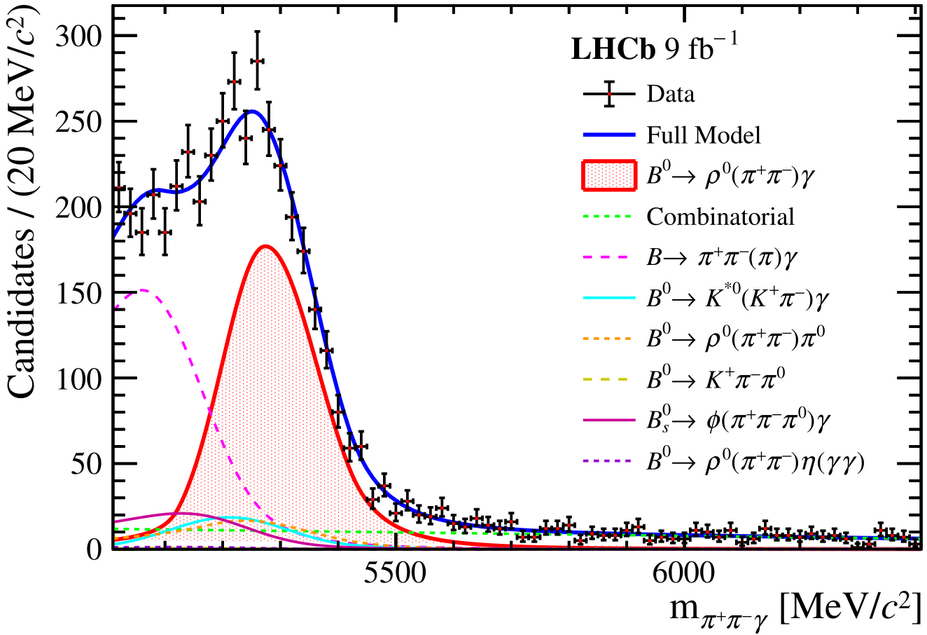
In this talk, I present the latest measurement of $B^0 \to \rho^0 \gamma$ at LHCb using proton–proton collision data collected during Run 1 and Run 2 of the LHC. I describe the analysis strategy, including the multivariate techniques employed for signal selection and background suppression, and present the resulting branching fraction measurement and its implications for the CKM unitarity triangle.