Choisissez le fuseau horaire
Le fuseau horaire de votre profil:
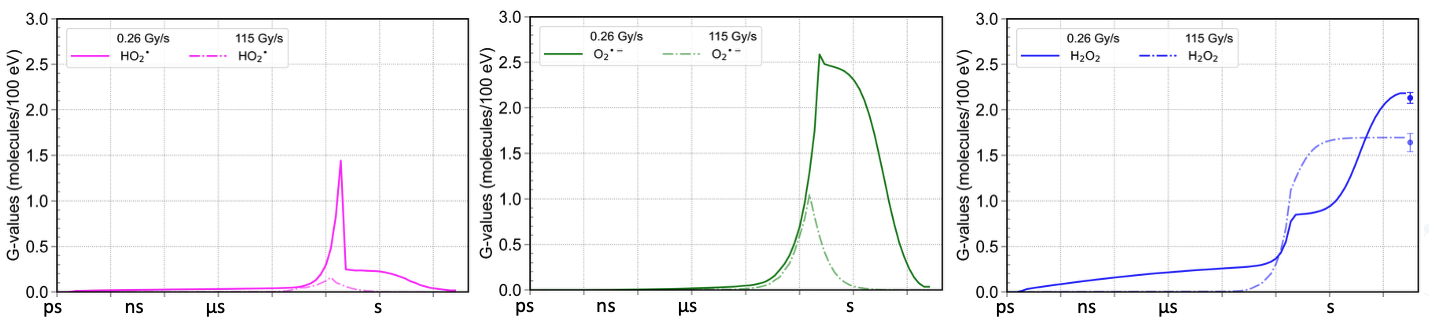
Radiotherapy is one of the main modalities for cancer treatment with the primary goal of eradicating tumour cells while preserving surrounding healthy tissue. Despite continuous technological improvements in beam delivery and treatment planning, normal tissue toxicity remains significant. Since 2014, high-dose-rate radiotherapy (> 40 Gy/s) has gained significant momentum due to its ability to spare normal tissue while maintaining an effective tumour control. This phenomenon, known as the FLASH effect, has been consistently observed in preclinical studies and is considered one of the most promising advances in modern radiotherapy. The prescribed dose is delivered within an extremely short time, from microseconds to milliseconds, but the mechanisms underlying normal tissue protection remain unclear and require understanding, beyond physical interactions, the chemical and biological processes involved. Ionizing radiation induces water radiolysis, producing reactive oxygen species (e.g., •OH, H2O2) that oxidize DNA, causing strand breaks and chemical modifications critical to radiation-induced cell death. To investigate these mechanisms, using the GATE platform and the Geant4-DNA library, we developed a multi-scale digital twin of a ultra-high dose rate 67.5 MeV proton beam (ARRONAX, IBA Cyclone 70XP, Nantes) impinging a ultra-pure water sample (pH=5.5) and compared our simulations with water radiolysis chemistry experiments handled by radiochemists from the Subatech laboratory. We could reproduce various oxygen levels, CO2 contents, and dose-rates conditions to follow species along time (from 10-12 to 15 min after irradiation).
We extended the study until the evaluation of DNA strand breaks using a clustering algorithm to be compared in a near future with biological experiments on cell populations. This seminar will discuss recent advances in high-dose-rate radiotherapy and radiation-induced chemical and biological processes, highlighting the integration of experimental data and computational modelling.