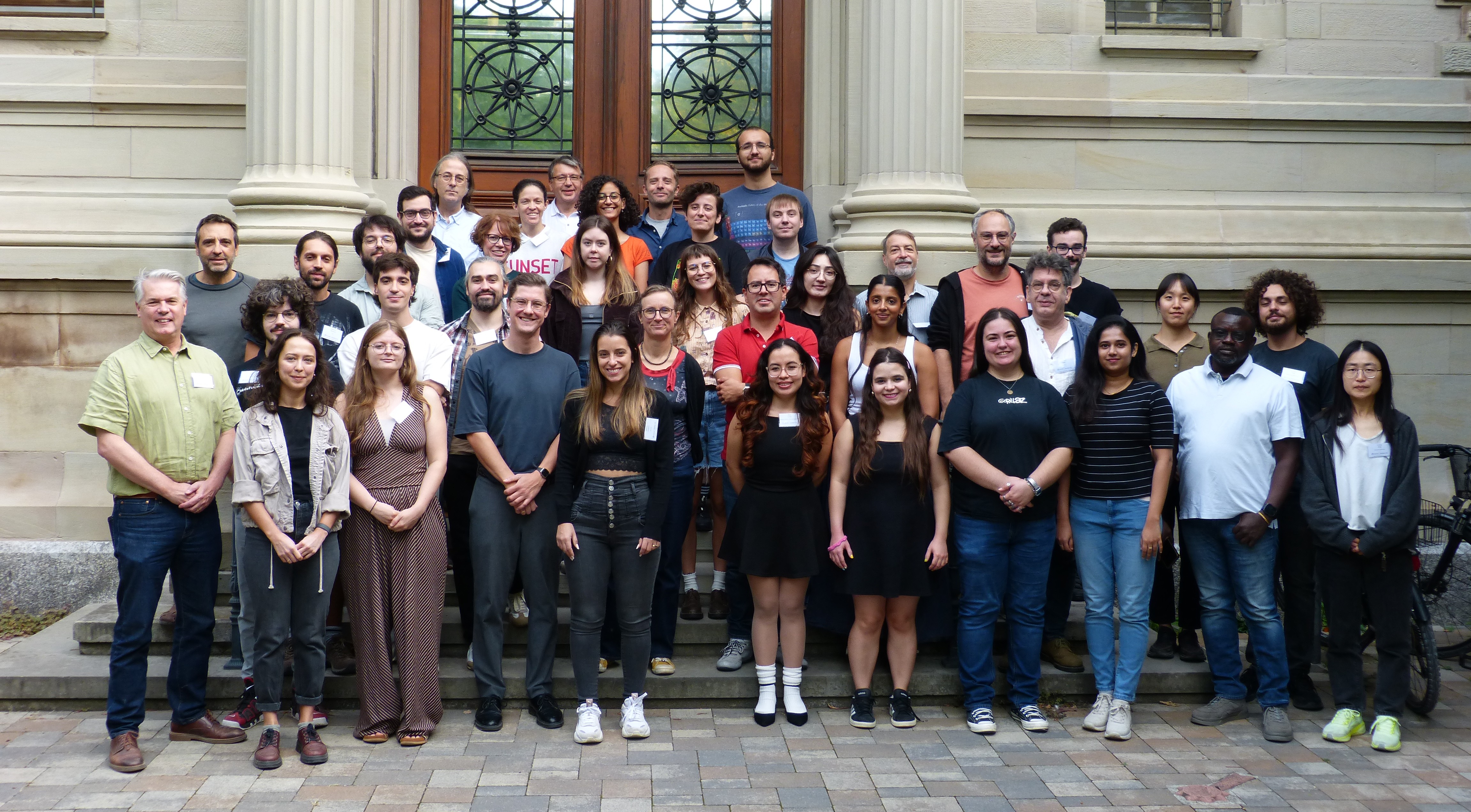
This Training Event of the Astronomy Competence Centre Pilot project (Astro-CC Pilot) will take place in the Observatoire Astronomique de Strasbourg (France) from 29 September to 01 October 2026.
The Virtual Observatory (VO) provides ways of accessing and exploiting the huge amount of data provided by the ever-growing number of ground-based and space facilities.
This training event is targeted towards Ph.D students and postdoctoral researchers in the astronomy, planetary, and heliophysics fields.
The participants will be exposed to the tools and services provided by the Virtual Observatory. Each tutorial will have a scientific application in mind. The tutorials will be:
- The Astronomical Data Query Language (ADQL) which provides a unified way of accessing tabular datasets across data archives,
- The Tool for OPerations on Catalogues And Tables (TOPCAT) software. TOPCAT is a VO-friendly desktop application for manipulating tables in astronomy. This tutorial will introduce TOPCAT by working with data from Gaia DR3. It will give you hands-on experience of using the tool to query remote data services via VO protocols, set up and explore interactive plots, manage row selections and perform crossmatches to analyse catalogue data in detail. There will also be an opportunity to perform similar analysis programmatically using STILTS, TOPCAT's command-line counterpart.
- The Strasbourg Astronomical Data Centre (CDS) services.
This tutorial will present both web-based and Python-based access to the services of the CDS. Through a hands-on workflow, participants will retrieve and combine data related to carbon stars using major CDS services.
The participants will explore the diverse information available in SIMBAD, including object properties, classifications, and bibliographic links. Participants will then learn how to navigate VizieR to identify relevant catalogues by scientific theme and data content. We will also cover techniques for cross-matching multiple carbon star catalogues.
Finally, the retrieved data will be visualized using the Aladin sky (and planetary) visualization tool, both through the desktop application and its Jupyter-based interface (iPyAladin).
This tutorial is intended for participants interested in astronomical data discovery, and catalogue interoperability.
- The Virtual European Solar and Planetary Access (VESPA)
This tutorial will introduce advanced methods for accessing and analyzing planetary science data, with a focus on Mercury and the BepiColombo mission. It will present workflows for querying datasets through multi-criteria selection and the MOC (Multi-Order Coverage) framework via the PADC FindMe portal.
Participants will explore how to use the VESPA geospatial portal to identify spectral data within specific morphological units on Mercury.
As an optional extension, the session will cover the extraction of asteroid spectra from the Gaia database, highlighting an area of growing importance in planetary science.
This hands-on tutorial is designed for users interested in planetary data discovery, and emerging tools for planetology.
- The Virtual Observatory SED Analyzer (VOSA)
This tutorial demonstrates the use of VOSA, the Spanish Virtual Observatory (SVO) tool developed to estimate stellar physical parameters by fitting spectral energy distributions. The tool allows users to upload their own photometric data or collect it from VO catalogues. Through three practical scientific cases, this exercise will guide participants in exploring VOSA's main functionalities, - The Space-Time Multi-Order Coverages (ST-MOCs)
This advanced tutorial will introduce the use of Space-Time Multi-Order Coverages (ST-MOCs) to access and combine datasets based on both spatial and temporal criteria. We will learn how to construct and manipulate ST-MOCs to perform data discovery.
As a practical application, we will identify Gamma-Ray Bursts observed by both the Fermi Gamma-ray Space Telescope and the XMM-Newton X-ray Observatory by intersecting their observational coverages in space and time.
Participants will also explore the Virtual Observatory registry to discover relevant data services, and will gain hands-on experience using key interoperability standards introduced in the training event, including UCDs, ADQL, MOCs.
This session is intended for participants seeking to deepen their understanding of Virtual Observatory technologies and to perform sophisticated multi-wavelength and multi-dimensional data queries.
The installation instructions for the software that we will use during the event is available here. An online help-desk session will be held on September 25 at 2pm CEST. The link to join it has been sent to the participants.
Along these tutorials, some time will be allocated to the participants personal scientific projects. With the help of the training event tutors, they will directly apply their new knowledge to their own scientific use case.