Choisissez le fuseau horaire
Le fuseau horaire de votre profil:
Global observables such as the pseudorapidity distributions of particle multiplicities in the final state are crucial to shed light on the physics processes involved in hadronic collisions. Particle production at the LHC energies arises from the interplay between hard and soft QCD processes and is sensitive to non-linear QCD evolution in the initial state. For Run 3 of the LHC, ALICE has upgraded its detectors, increasing its pseudorapidity coverage and tracking of charged particles over a wider range of pseudorapidity by combining the information from the upgraded Inner Tracking System (ITS) and the newly installed Muon Forward Tracker (MFT). These new detectors enable the exploration of particle-production mechanisms by addressing the charged-particle pseudorapidity densities, measured over a wide ($\eta$) range, in pp and Pb--Pb collisions.
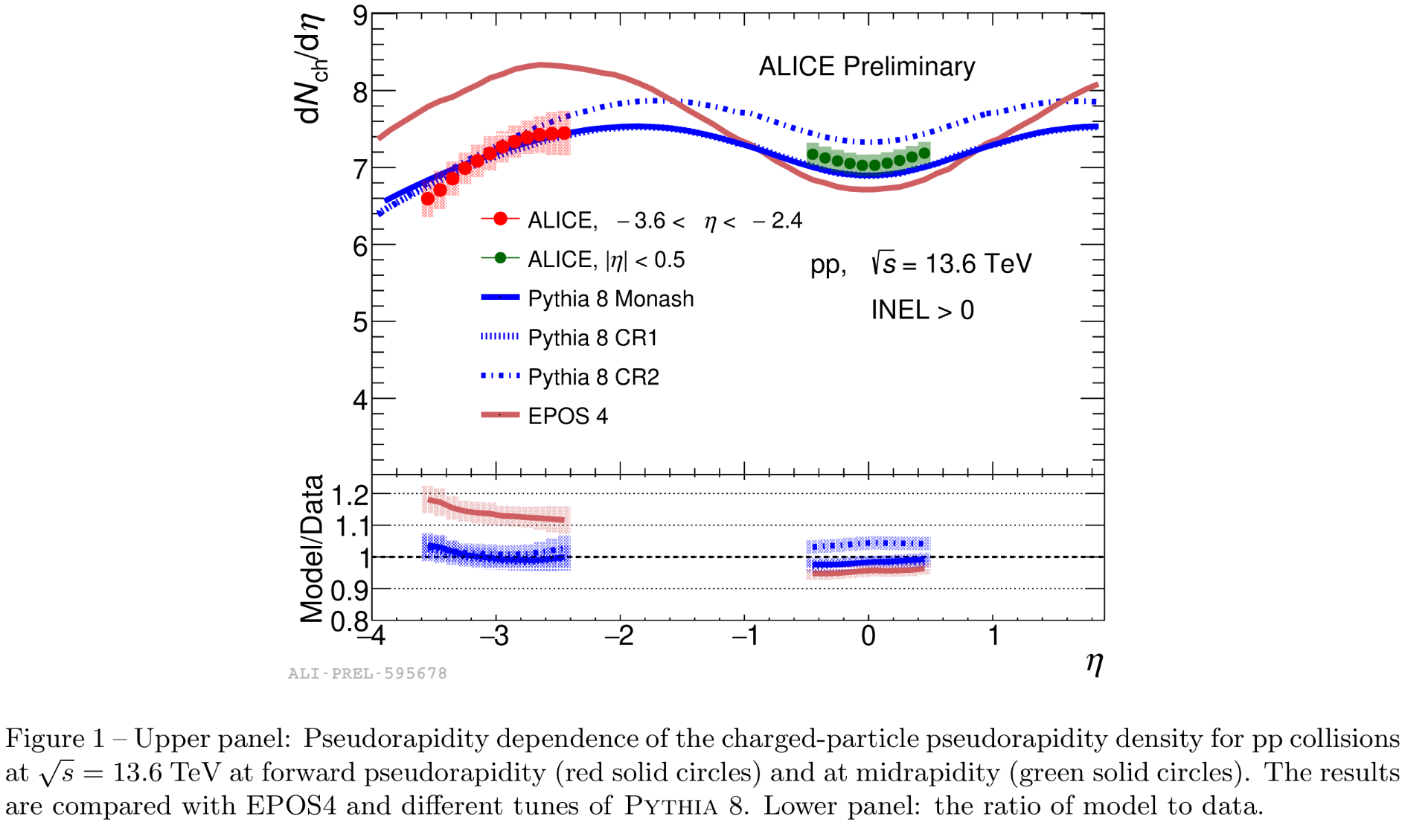
In this talk, the first measurements of the charged-particle pseudorapidity density, (${\rm d}N_{\rm ch}/{\rm d}\eta$), in proton--proton (pp) collisions at ($\sqrt{s}=13.6$) TeV and in lead--lead (Pb--Pb) collisions at ($\sqrt{s_{\rm NN}}=5.36$) TeV will be presented. The average charged-particle pseudorapidity density ($\langle {\rm d}N_{\rm ch}/{\rm d}\eta \rangle$) in pp collisions is measured at midrapidity ($|\eta|<0.5$) with the upgraded central barrel detectors and, at forward pseudorapidity ($-3.6<\eta<-2.4$), using the MFT. The measurements will be compared with models based on various particle-production mechanisms and different initial conditions at mid and forward rapidities.