Choisissez le fuseau horaire
Le fuseau horaire de votre profil:
Wide-field time-domain surveys are uncovering increasing numbers of luminous, long-lived, hydrogen-rich transients that defy traditional classification schemes. Distinguishing between superluminous supernovae, tidal disruption events, and active galactic nucleus variability is often far from straightforward, yet accurate classification is essential for understanding the physical mechanisms that drive an observed transient.
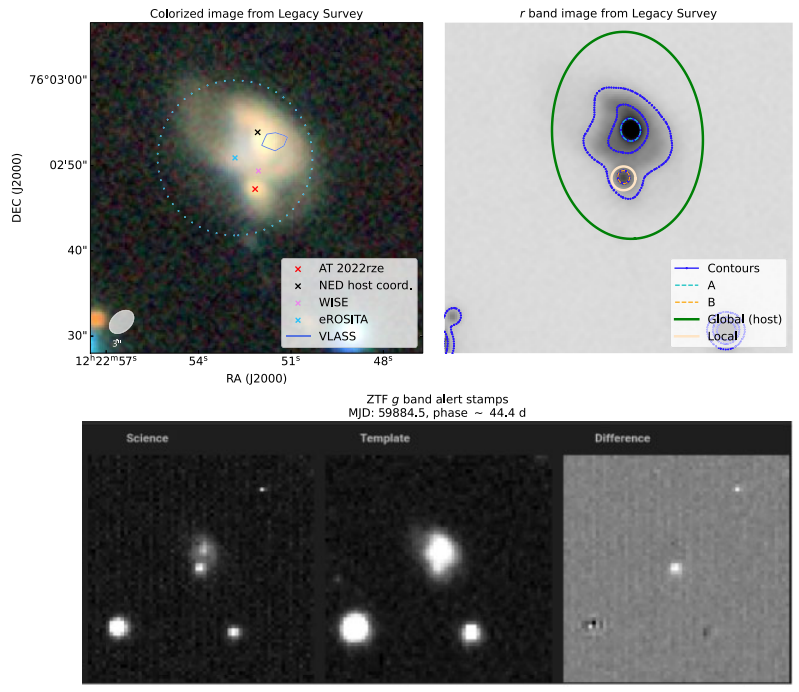
In this talk, I present AT2022rze, an enigmatic transient initially classified as a Type IIn supernova but displaying properties that overlap with several other classes. Using intensive optical follow-up and archival multiwavelength data, we place constraints on its nature and powering source. As the Vera C. Rubin Observatory’s LSST begins operations, such ambiguous events will become increasingly common, highlighting the urgent need for efficient, coordinated classification strategies in the era of large-scale time-domain surveys.