IMPORTANT: Registration is now open and will close on 31 March 2026
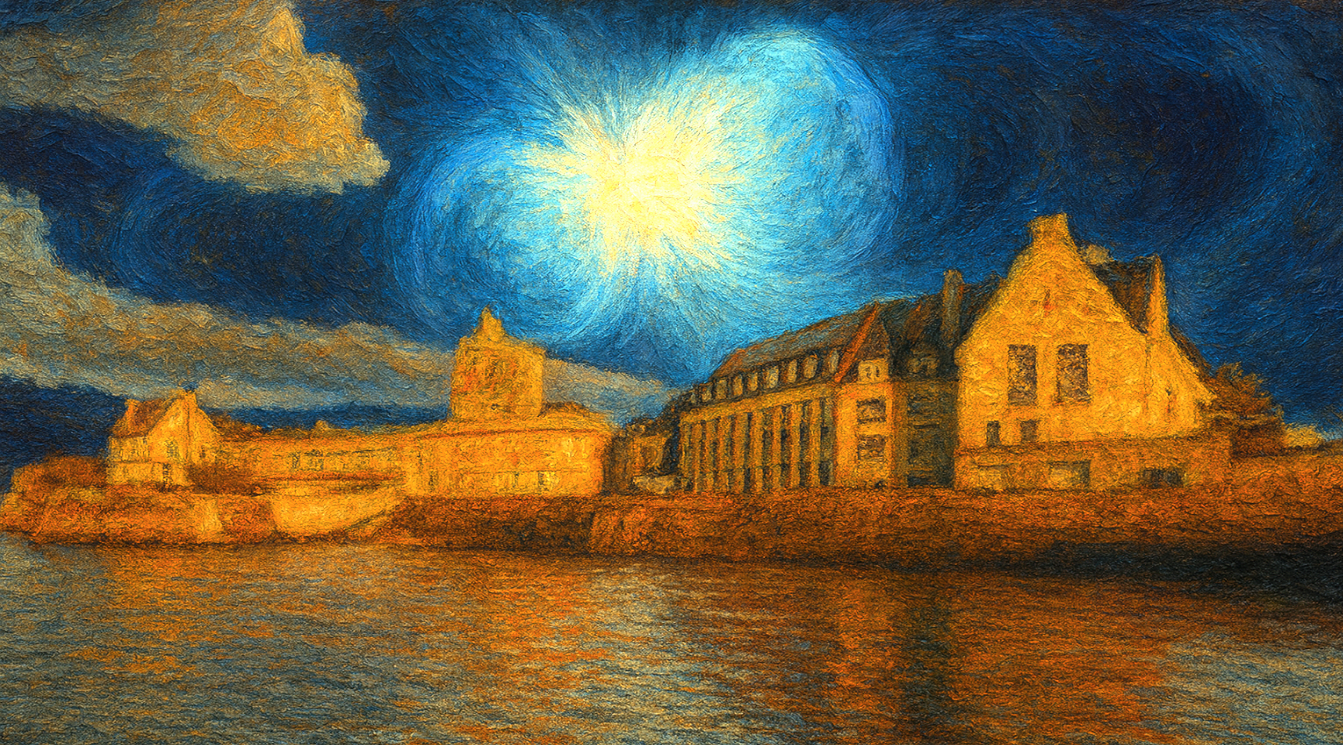
The thematic school Gravitational Waves emission from proto-neutron stars and Neutron Star mergers (GWsNS-2026) is a graduate school that will cover several aspects of the gravitational wave (GW) emission from neutron stars, with special attention to neutron star mergers and proto-neutron stars. This is the 2026 edition of the event GWsNS-2023 (check the website for the lecture material of the previous edition!), and will take place at the Station Biologique de Roscoff (Brittany, France), a CNRS facility with full conference infrastructure and on-site accommodation.
The rapidly evolving field of multi-messenger astronomy and the arrival of third-generation detectors (like the European Einstein Telescope project and the American Cosmic Explorer) are expected to lead to further advances in both our understanding of neutron star astrophysics and the possibility of constraining theoretical models of ultra-dense matter with astronomical observations.
A complete understanding of the observations expected from third-generation gravitational-wave detectors will only emerge through a close dialogue between theory and data. Achieving this demands a broad and interdisciplinary skill set — spanning nuclear and hadronic physics, numerical relativity simulations, Bayesian inference, and multi-messenger astronomy.
The GWsNS-2026 school aims to bring together both young and experienced researchers wishing to gain a comprehensive view of this rapidly evolving and highly interdisciplinary field.
This event adheres to the Code of Conduct of the French Society of Astronomy and Astrophysics (SF2A), which sets out expected standards of professional and respectful behaviour and the procedures for reporting and addressing misconduct (see the PDF in the “Materials” section below).