Choisissez le fuseau horaire
Le fuseau horaire de votre profil:
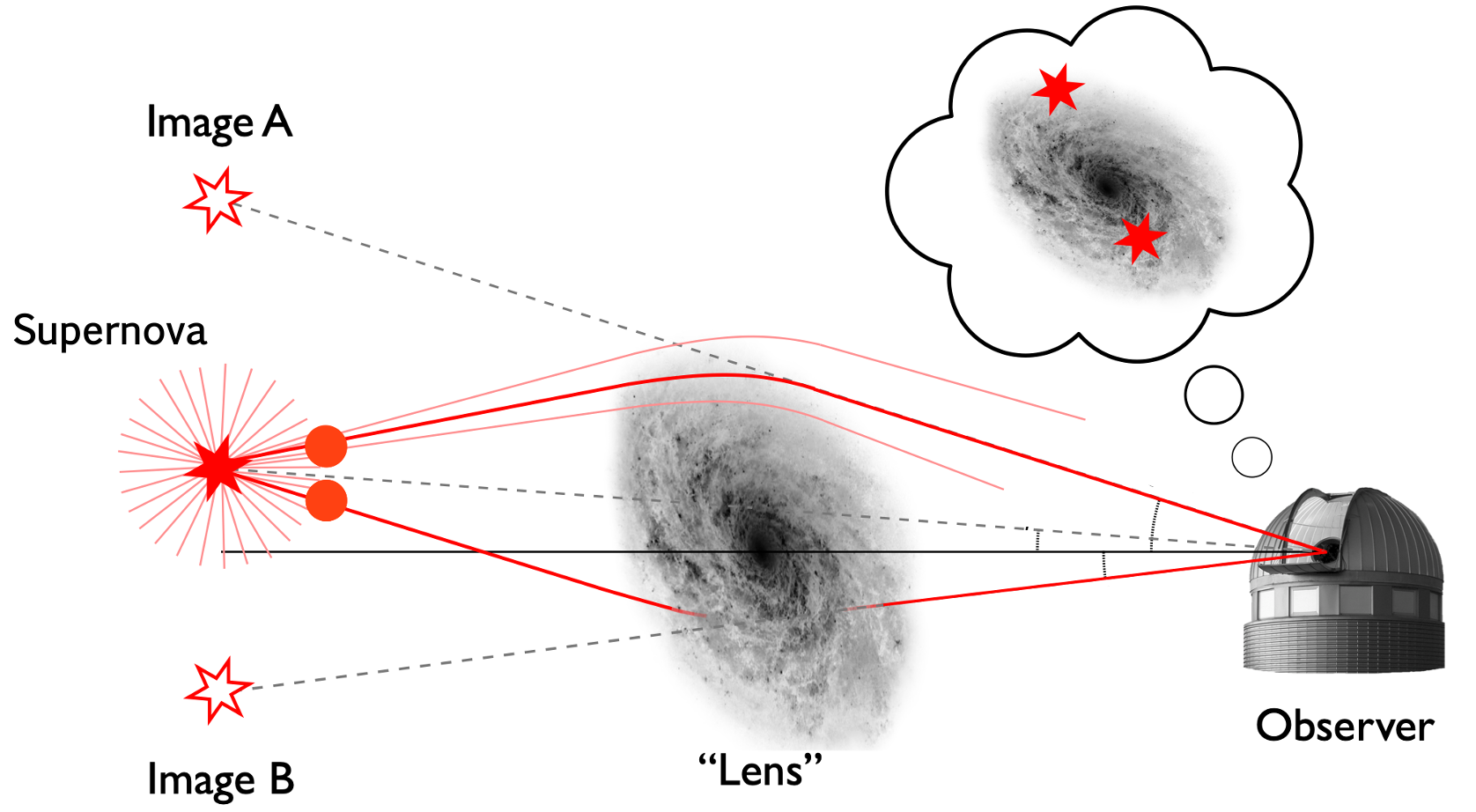
Strong gravitational lensing, a prediction of general relativity, occurs when light from a distant source is deflected and magnified by the gravitational field of an intervening massive object. This lens -- typically a galaxy, galaxy cluster, or supermassive black hole -- acts as a natural gravitational telescope, enabling the observation of sources in the high-redshift universe. While numerous strongly lensed galaxies and quasars have been observed over the past few decades, the study of gravitationally lensed supernovae has emerged as a rapidly growing area of research. Strongly lensed Type Ia supernovae are especially valuable because their standardisable luminosities allow precise measurements of lensing magnifications and cosmological distances, thereby providing direct constraints on the Hubble constant. In this talk, I will present an overview of the lensed supernovae discovered to date by both ground- and space-based surveys, discuss their use in cosmology, and outline future prospects for discovering these events with upcoming surveys such as the Rubin Observatory’s Legacy Survey of Space and Time (LSST) and beyond.