Orateur
Description
The appearance of a subshell closure in $^{56}$Cr (N=32) is confirmed by high excitation energy of the 2$^{+}_{1}$ state and reduced B(E2;2$^{+}_{1}\rightarrow$0$^{+}_{1}$) but shell model calculations do not reproduce the drop of collectivity at N=32.
The discrepancy between the experimental data and the theoretical calculations for $^{56}$Cr may be as a result of coexisting shapes in this nucleus and triaxiality which greatly reduces the B(E2) values. Indeed, calculations performed with the AMD+HFB framework aiming to investigate the triaxial deformation of the states and shape coexistence in this region show coexisting prolate and spherical shapes along the N=32 isotonic chain with the largest deformation in chromium isotopes. Triaxial deformation lowers the excitation energy of the 2$^{+}_{1}$ state a few hundred of keV and reduces the B(E2) values, being able to reproduce the drop of collectivity at N=32 in agreement with experimental data, but still the theoretical values of B(E2) remain much higher than the experimental ones.
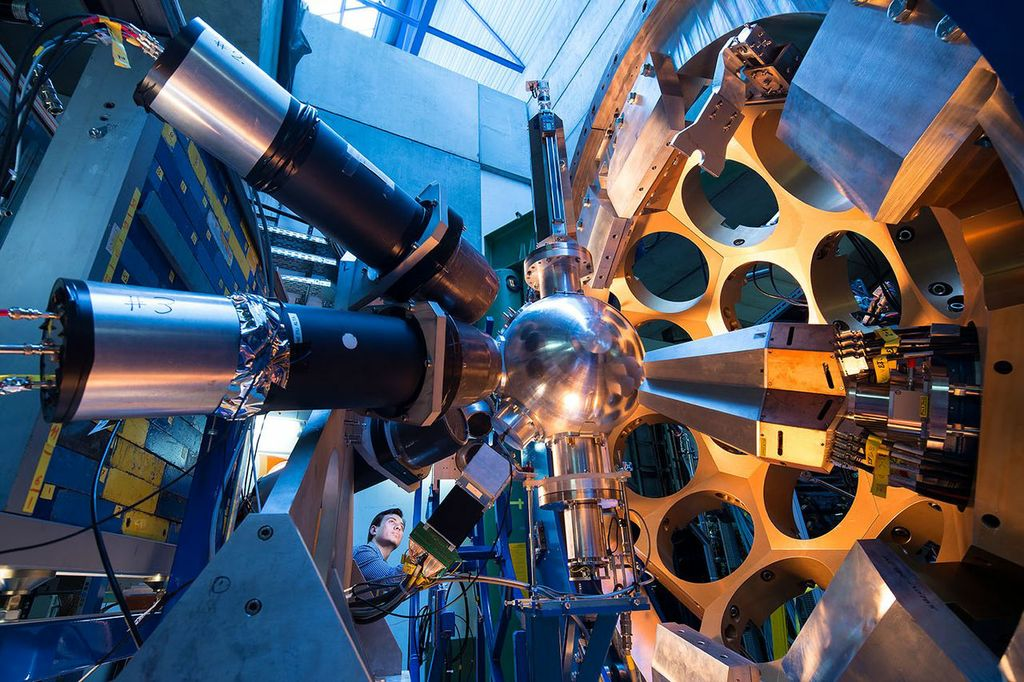
Shape coexistence and triaxial deformation will be studied via lifetime measurements of the 0$^{+}_{2}$ and 2$^{+}_{2}$ states in $^{56}$Cr employing the RDDS/DSAM technique. The states of interest were populated using a transfer reaction: $^{54}$Cr($^{18}$O,$^{16}$O)$^{56}$Cr. The AGATA array was coupled with the SPIDER detector to reach the needed channel selectivity and control the feeding of the states of interest from higher lying states.