Orateur
Description
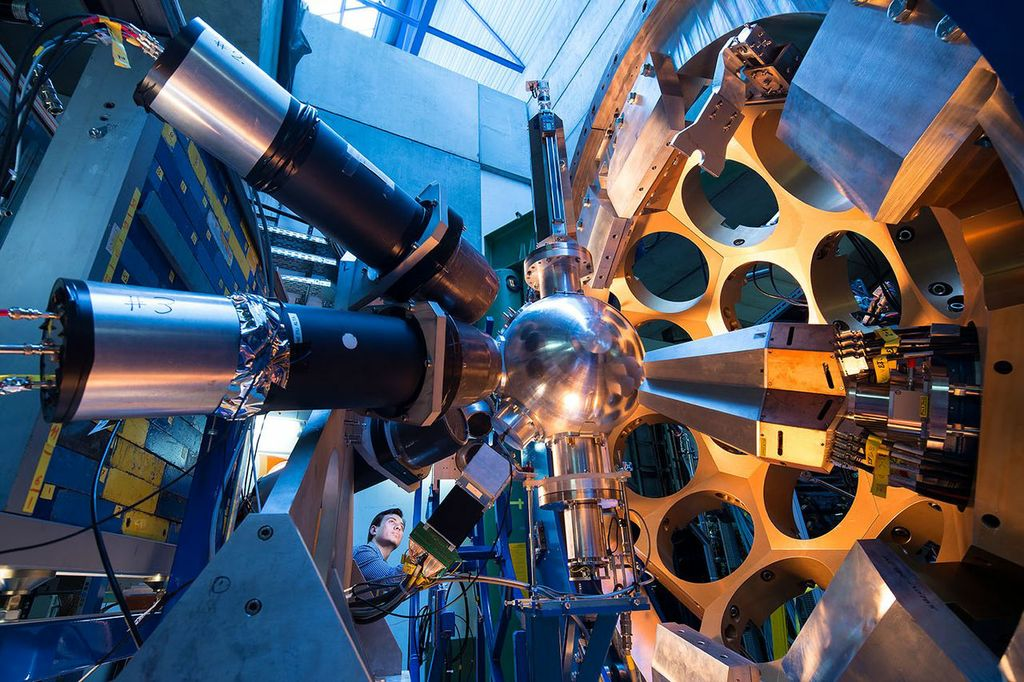
In December 2022, an experiment was performed at INFN-LNL with a $^{208}$Pb beam at 1300 MeV impinging on a $^{9}$Be target, using the inverse kinematics fusion-fission reaction for both nuclear structure and reactions studies. The experiment was performed using the AGATA $\gamma$-ray tracking array coupled to the magnetic spectrometer PRISMA [1-3].
This setup allowed one to measure the $\gamma$ rays from the de-excitation of the fission fragments and to study the dynamics of the fission of the compound nucleus, $^{217}$Rn.\
One of the interesting nuclear structure issues ~\cite{moeller_prc_2015}that can be tackled in the neutron-rich region reached through the fission of this system is the evolution of the shell gap at $N=50$.
The observation of the reduction of the $N=50$ shell gap [4-5] is a phenomenon that motivated different measurements in the $N=50$ isotones towards $^{78}$Ni.
In particular, estimates starting from mass measurements show a decrease of the $N=50$ gap size from $Z=40$ until $^{82}$Ge, while for $^{80}$Zn a re-increase is observed[4-5]. A second method to estimate the gap size is with the energy of medium-spin states in $N=50$ even-even isotones.
The fusion-fission reaction mechanism is an effective production method for spectroscopy of these levels because it can populate states at higher spins than transfer reactions, up to 6-8 units of angular momentum [6].
While the production cross section for the very exotic $N=50$ nuclei with $Z<31$ becomes small, the less neutron-rich isotopes in this region are populated with higher yields and a more detailed spectroscopy of their excited levels is possible.
We will show preliminary results on $\gamma$-ray spectroscopy of $N=50$ isotones as well as $N=40-50$ Zn and Cu isotopes.
In parallel to the $\gamma$-ray spectroscopy of the energy levels of the fission products, the measurement of the fragments with the large acceptance spectrometer PRISMA gives access to key quantities for the description of the fission dynamics of the $^{217}$Rn compound nucleus.
In recent studies, the role of nuclear structure in the dynamics of fission has been investigated with different systems in the actinide region. These studies showed that even in highly-excited fissioning systems, such as $^{250}$Cf at $E^*=45$~MeV [7], where the high excitation energy is expected to wash out the shell effects and produce a symmetric fission, contributions from different fission modes associated with structure effects could not be excluded.
Therefore, the fusion-fission of $^{217}$Rn, which lies in a region where symmetric fission is expected at low energies [8], represents an interesting case to understand the role of shell effects at high excitation energy in a region that is much lighter than the actinides that was never studied before.
The measurement of the fission fragments with PRISMA allows the $(A,Z)$ identification and the reconstruction of the fragment velocities in the center of mass of the fissioning system.
After the optimization of the fission fragment identification we will present preliminary results on reconstructed fission yields.