Orateur
Description
The region around doubly magic $^{48}$Ca is a cornerstone of our understanding of nuclear structure, characterized by the appearance of subshell closures at N=32 and 34 [1], and by the gradual disappearance of N=28 shell closure below Z=20 [2]. However, several experimental findings have challenged this understanding. Large charge and matter radii were found in $^{51-53}$Ca [3,4], showing insensitivity to the N=32,34 subshell closures. The long-standing conundrum of the small B(E2) value in Ar [5,6] has recently been attributed to a new proton sub-shell closure at Z=18 in Ar [7].
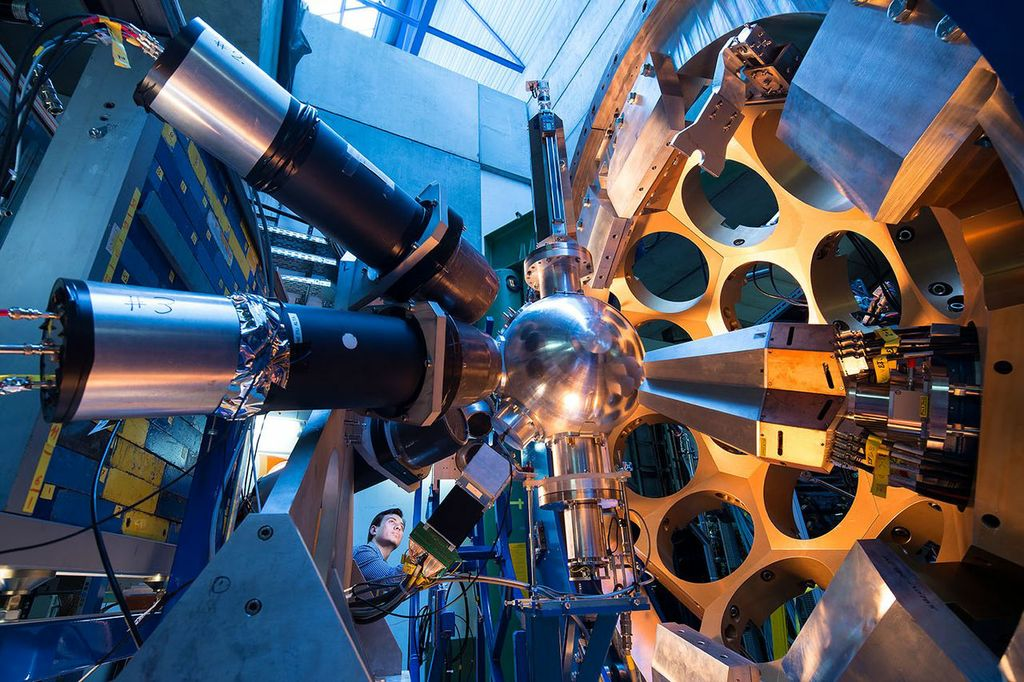
We measured lifetimes of excited levels in $^{50-(52)}$Ca and $^{46-(48)}$Ar isotopes (and other nearby nuclei) produced in a multi-nucleon transfer reaction at the Legnaro Laboratories. A beam of 48Ca at 300 MeV impinged on a U target and the target-like recoils were identified event-by-event in mass and atomic number by the mass spectrometer PRISMA [8]. Gamma rays were measured in coincidence with reaction recoil with the AGATA $\gamma$-ray tracking array [9]. Lifetimes were measured using the recoil differential Doppler shift method by mounting the uranium target on a plunger device. Shorter lifetimes were probed using the differential Doppler shift attenuation technique, using a U target with a thick niobium backing. Thanks to the cutting-edge AGATA resolving power, the lifetimes of several yrast and yrare states with spin ≤ 4 were measured.
We will present preliminary results concerning the analysis status.
[1] D. Steppenbeck et al., Nat. 502, 207–210 (2013)
[2] T. Glasmacher et al. Phys. Lett. B, 395, 163 (1997)
[3] R. F. Garcia Ruiz et al., Nat. Phys. 12, 594 (2016)
[4] M. Tanaka et al., Phys. Rev. Lett. 124, 102501 (2020)
[5] A. Gade et al., Phys. Rev C 68, 014302 (2003)
[6] S. Calinescu et al., Phys. Rev. C 93, 044333 (2016)
[7] D. Brugnara et al., submitted
[8] A. Stefanini, et al. Nuc. Phys. A, 701, 217 (2002)
[9] S. Akkoyun et al, NIM A 668, 26 (2012)