Orateur
Description
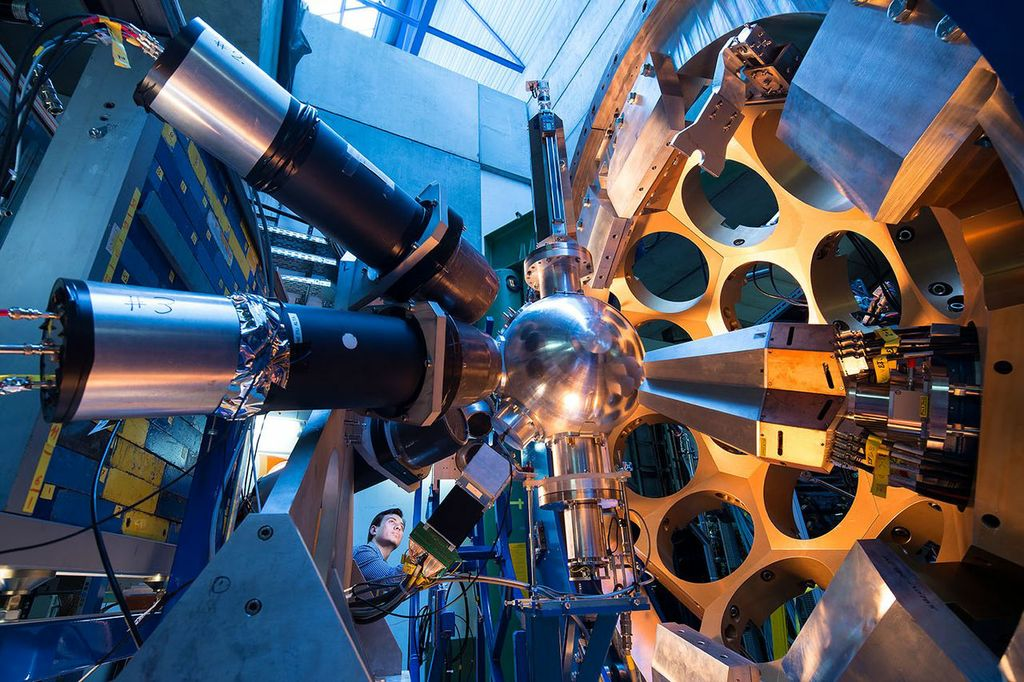
We report preliminary results from the measurements of the superallowed $^{10}$C β-decay branching ratio with the AGATA HPGe tracking array at INFN-LNL. The precedent experiment, Exp. 22. 72 was performed in June 2023. A 10-MeV proton beam accelerated from the Tandem-XTU impinged to a 1-mg/cm$^2$-thick, Au-sandwiched $^{10}$B target. The experiment was run in two modes: in-beam mode and decay mode. The in-beam mode employed a continuous beam, and the decay mode used a cycle of beam on-axis for 60 seconds and off-axis for 120 seconds using a beam steerer. The AGATA was employed to detect γ rays from $^{10}$B following the β decay of $^{10}$C, and γ rays from the inelastic scattering of $^{10}$B, to determine the count and efficiency ratios of the 1022-keV and 718-keV γ rays in the $^{10}$C β-decay. We also measured the lifetime of the $^{10}$C with same dataset.
After the experiment, we improved our idea to make the setup capable of high-count rate, and performed the test experiment, Exp. 24. 12 last December. We employed a tantalum target ladder, a tantalum mask, and a $^{10}$B target with carbon backing to suppress the background. The new logical signal-based trigger and the new trigger processing could increase the maximum count rate to 4 kHz in decay and in-beam modes. The new experiment was performed this July and according to the preliminary result, a statistical uncertainty less than the 0.2% level on the branching ratio is anticipated.