Choisissez le fuseau horaire
Le fuseau horaire de votre profil:
D2i2 is proud to announce the 11th edition of our workshop "Perspectives"!
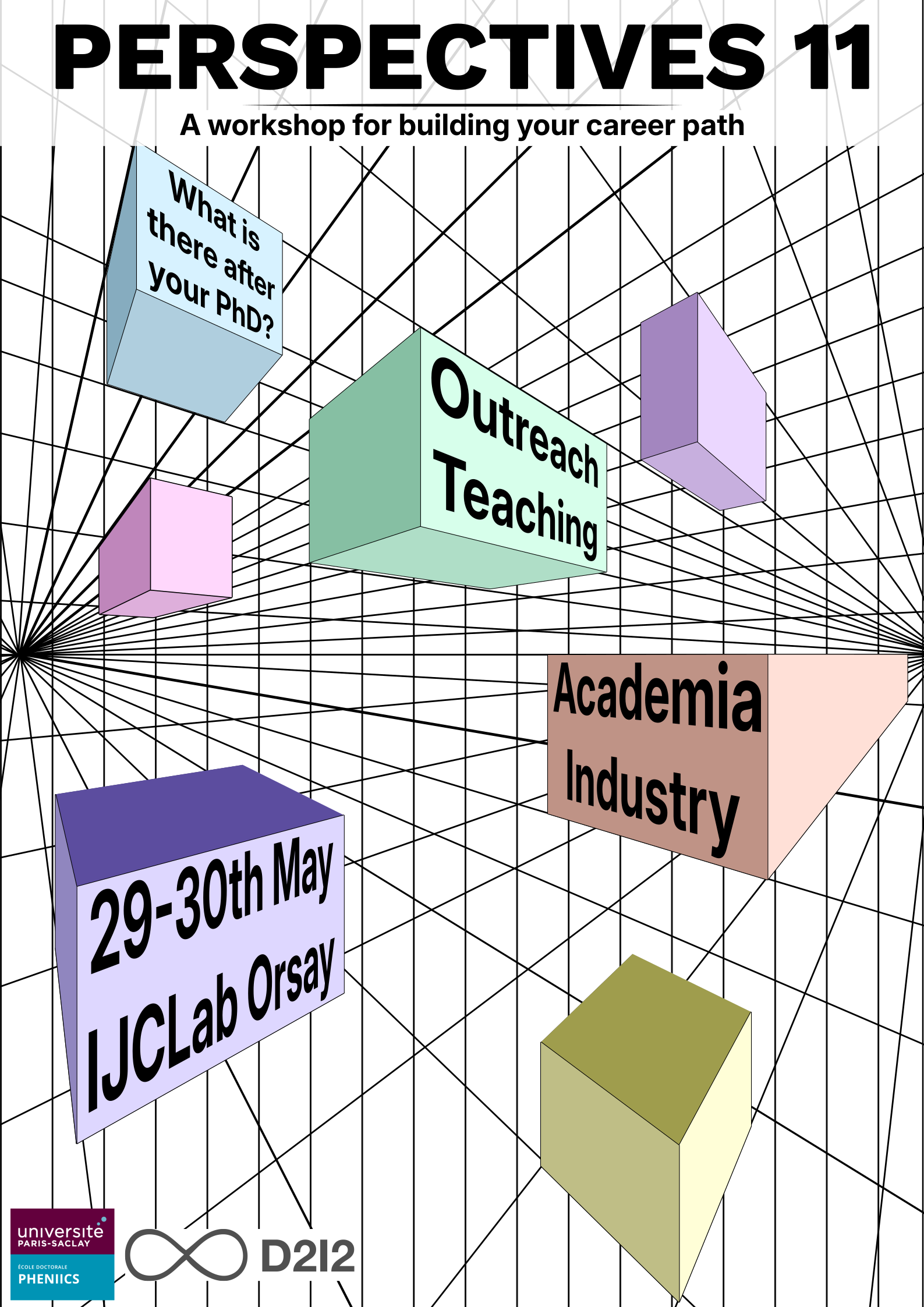 Registrations are now opened!
Whether your PhD thesis is just starting, advancing, or a distant memory, these two days will answer your most serious questions about your professional future in a friendly and relevant environment. During the workshop, about 15 speakers are invited, researchers in the public and private sectors, working in outreach, teachers, working in start ups or large companies... Recruitment and occupational integration specialists will also be present.
During round tables or within small-group activities, they will explain their path and their actual work, will detail the terms and conditions of competitions for public research, and demystify how recruitment works in the private sector. These two days will give you a broad view of the available perspectives after a PhD thesis in our fields.
The PHENIICS doctoral school sponsors this event, and will account it as one of your doctoral training, as long as you take part in the two days of the event. For the fourth year, the workshop will be hosted in English.
Registration is free, and not only reserved to D2i2 members. All PhD students from any doctoral school is welcome. Lunch and coffee breaks are provided within the limit of participation numbers.
The D2I2 association (which stands for Doctorants et Docteurs des 2 Infinis) is an association mainly based in the IJCLab and the CEA. However, it also manages all the (PhD) students working for the IN2P3 part of the CNRS in Ile-de-France. Its main objective is to foster a welcoming environment and a natural network between students starting their research careers.
To this end, monthly informal bar meetings are organised in Paris between people from different laboratories to improve relations between different organisations. An annual workshop (Perspective) is also organised to present the different career paths that can be chosen after the PhD.
Alessandro Manzotti obtained his PhD in molecular biology and functional genomics in 2022 at Sorbonne Université. Having decided to change of professional path and put his scientific background to use for environmental and social issues, he attended a master's degree in environmental studies at the École des Hautes Études en Sciences Sociales (EHESS) in Paris. He now works as a research and advocacy officer for the NGO BLOOM.
Camilla holds a PhD in Physics from Sapienza University of Rome. After several years of postdoctoral research within the ATLAS experiment at CERN, she decided to transition into the science museums sector. She then completed a master's degree in history of science and scientific heritage at Université Paris Cité. Following a first experience as a "médiatrice scientifique" at the Palais de la Découverte, Camilla is now "responsable de la médiation culturelle" at the Musée Curie in Paris. Together with her team, she designs and leads museum activities, develops special events and outreach initiatives linked to major cultural events throughout the year (JEP, fête de la science, nuit des musées...), and creates mediation content and tools for onsite, outreach, and online audiences.
Nathalie Ayi is an Assistant Professor in applied mathematics at the Jacques-Louis Lions Laboratory at Sorbonne Université and a member of the Institut Universitaire de France. She specializes in partial differential equations. Alongside her research, she is deeply committed to promoting diversity and gender equality in science through outreach activities aimed at encouraging younger generations to pursue scientific careers. She is the creator of the podcast Tête-à-tête Chercheuse(s), dedicated to the journeys of contemporary scientists, and also contributes to La Saga des Maths, a podcast produced by France Inter.
Useful links
- GALAXIE for "enseignants-chercheurs":
https://www.galaxie.enseignementsup-recherche.gouv.fr/ensup/candidats.html
- "concours" researchers:
http://www.dgdr.cnrs.fr/drhchercheurs/concoursch/default-fr.htm
- section (IN2P3) 04 website for information:
https://section04.in2p3.fr/
- section 19 (INSU, astrophysics, cosmology) website for information:
https://section19.obspm.fr/
- section 05 (theory) website for information:
https://section19.obspm.fr/
- Procedure for researchers in handicap situation:
https://carrieres.cnrs.fr/actualites/recrutement-2026-de-chercheuses-et-chercheurs-en-situation-de-handicap/
- "concours" engineers (not addressed here):
http://www.dgdr.cnrs.fr/drhita/concoursita/default.htm
Mental health is an important aspect of personal achievement. No goal should be pursued at the expense of one's physical or mental health. To this end, measures have been put in place to prevent issues and help people deal with them if they arise. This is the role of Nightline, which operates as a helpline to provide information on how to recognise such issues and the processes in place.
Zoom link: Here is the invite link for the Zoom, tomorrow from 2:15pm to 4:15pm: https://ijclab.zoom.us/j/95014524573?pwd=AwCMyD5kPidH7SXdfL7B4S3mmho9di.1
Béatrice Guénégo is a researcher at CEA Saclay. After completing an engineering course at CentraleSupélec, she went on to pursue a Master's degree at Université Paris-Saclay, specialising in electronic and electrical engineering. She completed her PhD at the GeePs laboratory at CentraleSupélec, specialising in the numerical conversion of biological signals.
Daniel Kerszberg is a physicist specializing in astroparticle physics, in particular very high-energy gamma-ray astronomy. He did his PhD at LPNHE (Laboratoire de physique nucléaire et de hautes énergies) in Paris from 2014 to 2017. He then joined IFAE (Institut de Fisica d'Altes Energies) in Barcelona (Spain) as a postdoctoral researcher from 2018 to 2023. He later returned to LPNHE as a CNRS staff researcher in 2024, where he has been based since then. He was a member of different gamma-ray experiments/collaborations during his PhD (H.E.S.S.) and postdoc (MAGIC, CTAO). He worked on cosmic-ray analysis, indirect dark matter searches and Lorentz invariance violation searches. Today he is mostly focused on the integration, deployment and commissioning of cameras for the future observatory CTAO.
Research Director at the French Alternative Energies and Atomic Energy Commission (CEA), within the Institute of Research into the Fundamental Laws of the Universe (Irfu). He obtained a Master’s degree in Astrophysics and Instrumentation from Pierre and Marie Curie University, followed by a PhD in nuclear astrophysics at CEA/Irfu, completed in 2005. His doctoral work focused on the calibration of a space-based gamma-ray spectro-imager.
Following his PhD, he taught physics for one year at the high-school level before returning to CEA/Irfu for a two-and-a-half-year postdoctoral position in the Particle Physics Division (DPhP). During this period, he contributed to the R&D of pixelated readout systems for Time Projection Chambers (TPCs) intended for the future International Linear Collider (ILC), where he pioneered the implementation of resistive technology in Micromegas detectors.
Since joining the Division of Electronics, Detectors and Computing for Physics (DEDIP) at CEA/Irfu in 2008, he has led and contributed to several detector development programs involving TPC technologies for both particle physics and gamma-ray astrophysics, including the HARPO project. After participating in the construction of Micromegas tracking detectors for the CLAS12 experiment, he now develops muon tomography telescopes for societal and industrial applications.
Meet & Drink at Orsay's 'Hall of Beer'
François Ginisty is a physicist specialised in Space Weather and Plasma physics. He graduated from École Normale Supérieure Paris-Saclay (2020) and obtained a PhD at CNES (2023), focusing on the operational impacts of space weather.
He subsequently held a post-doctoral position at the Laboratoire de Physique des Plasmas at École Polytechnique, working on space plasma modelling and data-driven approaches for heliophysics.
In the wake of these academic research experiences, François founded Augura Space, a deeptech NewSpace Start Up, which focuses on monitoring and forecasting Space Weather phenomena and its impact in space, in the air and ground-based.
Luc received his PhD in embedded electronics for the aerospace sector from the university of Grenoble in October 2024. His research work, carried out part-time at an ArianeGroup subsidiary, focuses on the hardening of digital components integrated into onboard aerospace systems in the face of severe radiative environments.
During his thesis, Luc had the opportunity to visit several specialized ESA and NASA test facilities around the world, to reproduce the effect of radiation on electronic components in an accelerated way.
Today, he works in R&T at Nuclétudes, an ArianeGroup sbsidiary located near the Saclay plateau, as a radiation engineer. His daily work is at the intersection of the two infinities, as he characterizes the way in which radiation-matter interactions in the infinitely small can disrupt the operation of probes and satellites used to study the infinitely large in space.
Vsevolod received his PhD in Particle Physics from IJCLab in 2024, where his research focused on the development and operation of particle detectors, as well as data analysis within the LHCb experiment at CERN. With a strong interest in detector technologies, he became particularly passionate about their real-world applications beyond fundamental research.
He currently works as an Application Engineer at Weeroc, a spin-off start-up from the OMEGA academic laboratory. The company specializes in integrated circuit design for detector signal readout, with expertise in embedded systems and software development. Vsevolod contributes to the R&D process by bringing a physicist’s perspective to the development, testing, analysis, and presentation of products tailored for diverse fields such as medical imaging, nuclear energy, space industry, climate science, high-energy physics and other.
Marine Vandebrouck is a researcher in nuclear physics at CEA Saclay. She is also one of the coordinator of the NPAC master (Noyaux, Particules, Astroparticules et Cosmologie).
Marion Pillas is a teacher/researcher at the IAP (Paris Institute of Astrophysics), in Sorbonne University, working in high-energy astrophysics. She passed the examination to become 'Maitre de conférence' in 2025 and is now a lecturer at the IAP