Choisissez le fuseau horaire
Le fuseau horaire de votre profil:
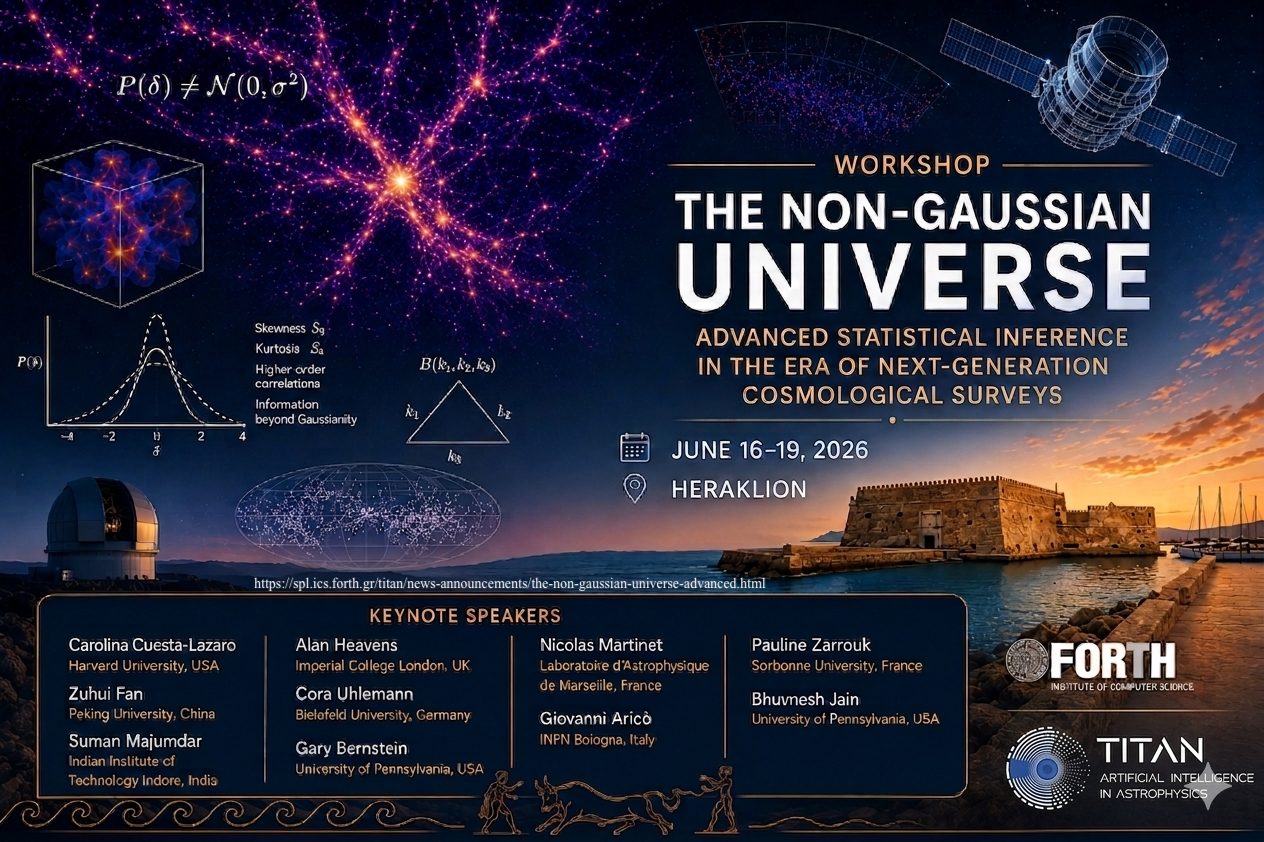
The era of Euclid, LSST, and SKA heralds a profound transformation in observational cosmology. As surveys approach the limits set by cosmic variance and systematic control, extracting maximal information from the cosmic density field demands a fundamental rethinking of how we perform cosmological inference. Traditional two-point statistics, while powerful, capture only a fraction of the information encoded in the nonlinear, non-Gaussian Universe.
This conference explores the emerging paradigm of full-information cosmology, bringing together approaches that move beyond the power spectrum, including high-order statistics, field-level inference, forward modeling, and simulation-based methods. By uniting developments across theory, simulations, and data analysis, the meeting aims to illuminate new pathways toward unbiased, robust, and information-optimal inference, and to define the statistical foundations of cosmology in the era of next-generation surveys.
SOC: Klea Panayidou, Natalia Porqueres, Marta Spinelli (Chair), Jean-Luc Starck (Chair), Greg Tsagkatakis, Panos Tsakalides, Stefano Camera
REGISTRATION DEADLINE: May 1st
Confirmed Keynote Speakers
Present-day cosmological cosmic shear fields are non-gaussian, which makes extraction of cosmological information challenging. I report on work done using extreme data compression of physics-based (power spectra) and neural-network derived summary statistics in a fully Bayesian SBI framework. Application to DES Y3 data shows significant improvement in cosmological precision, over 2-point statistics (3 x 2 pt).
Being sensitive to the non-Gaussianity of cosmic structures, weak-lensing (WL) peak statistics have been recognized as an important cosmological probe complementary to 2pt correlation analyses. In this talk, I will present our recent studies on WL peak steepness statistics inspired by machine learning feature explorations. This new analysis is sensitive to the density profile of halos that encodes important information of baryonic feedback and dark matter properties, enabling us to derive additional physical information from WL data besides cosmological parameter constraints. The impacts of galaxy intrinsic alignments on WL peak statistics will also be discussed. An introduction about the Chinese Space Station Survey Telescope (CSST) will be included.
To unlock the full potential of Stage IV weak lensing surveys, we must extract non-Gaussian information while mitigating small-scale astrophysical systematics. Positioned strategically between classical 2-point statistics and black-box neural networks, higher-order statistics (HOS) offer a balance of physical interpretability and high constraining power. However, their sensitivity to unmodeled baryonic feedback threatens this theoretical advantage. Leveraging simulation-based inference via neural posterior estimation, we quantify the parameter biases induced by baryons across varying survey footprints. To robustly mitigate these shifts, we investigate the efficacy of survey-dependent scale cuts, restricting our analysis to conservative, quasi-linear regimes. By comparing these mitigated HOS constraints directly against the standard angular power spectrum, we address a defining question for next-generation cosmology: do non-Gaussian statistics actually provide tangible, real-world gains, or is their advantage completely erased by the need to mitigate astrophysical systematics?
The nonlinear gravitational collapse of matter has shaped the intricate cosmic web of galaxies, creating a diverse range of density environments. Two-point statistics, widely used in galaxy surveys such as Euclid and Rubin LSST, average over these environments, potentially obscuring critical information. To maximise the scientific return of these surveys, we must explore the rich diversity of cosmic structures and non-Gaussian statistics. While higher order N-point correlation functions are often considered, I will explain how one-point statistics capture complementary information to two-point statistics and compress a set of higher-order correlations, providing a powerful tool for probing cosmology and extensions of ΛCDM. I will also explain how these insights can be applied to the one-point statistics of weak lensing and galaxy clustering, as well as their joint distribution, offering new avenues to probe fundamental physics.
This talk intends to put the Cosmological Principle (CP) to test by analyzing all-sky surveys of quasars and radio galaxies. CP asserts that the universe is isotropic and homogeneous on large scales. It attributes the Cosmic Microwave Background (CMB) thermal dipole to our local peculiar motion [1], hence giving it the name of kinematic dipole. If this attribution is correct, then all sky surveys of other cosmological probes should show a similar dipole in their distribution throughout the sky. More than forty years ago, researchers postulated the presence of a number count dipole in source distribution (dubbed as the matter dipole) as a test for the CP [2]. However, recent research [3] has found a disagreement between the matter dipole and kinematic dipole, with claims reaching well over 5σ! [4,5] I will put the CP to test by analysis of all sky surveys of quasars [6] and radio galaxies [7,8]. Using Bayesian statistics, I will show that a dipole aligned with the CMB is present. However, the amplitude of the dipole is still in tension with our expectations, bringing the validity of the cosmological principle into question [9,10]. We will also look into the future, discussing some outstanding issues in the domain and possible methods to increase the sophistication of the number count dipole test. [11,12]. [1]. Planck Collaboration et al., A&A, 641, A1 (2020). [2]. Ellis G. F. R., Baldwin J. E., MNRAS, 206, 377 (1984). [3]. Kumar Aluri P., et al., Classical and Quantum Gravity, 40, 094001 (2023). [4]. Secrest et al., ApJ, 937, L31 (2022). [5]. Dam L., Lewis G. F., Brewer B. J., MNRAS, 525, 231 (2023). [6]. Storey-Fischer et. al., ApJ, 964, 69, (2024). [7]. Hale C. L., et al., Publ. Astron. Soc. Australia, 38, e058 (2021). [8]. Condon et al., AJ, 115, 1693 (1998). [9]. Mittal V., Oayda O. T., Lewis G. F., MNRAS, 527, 8497 (2024). [10]. Oyada O. T., Mittal V., Lewis G. F., Murphy, T., MNRAS, 531, 4545 (2024). [11]. Oyada O. T., Mittal V., Lewis G. F., MNRAS 537, 1 (2024). [12]. Mittal V., Oyada O. T., Lewis G. F., OJAp 8, 143 (2025).
I will review past and ongoing efforts to exploit higher order weak lensing statistics within the Euclid Consortium.
We present SBi3PCF, a simulation-based inference (SBI) framework for analysing a higher-order weak lensing statistic, the integrated 3-point correlation function (i3PCF). Our approach forward-models the cosmic shear field using the CosmoGridV1 suite of N-body simulations, including a comprehensive set of systematic effects such as intrinsic alignment, baryonic feedback, photometric redshift uncertainty, shear calibration bias, and shape noise. Using this, we have produced a set of DES Y3-like synthetic measurements for 2-point shear correlation functions ξ± (2PCFs) and i3PCFs ζ± across 6 cosmological and 11 systematic parameters. Having validated these measurements against theoretical predictions and thoroughly examined for potential systematic biases, we have found that the impact of source galaxy clustering and reduced shear on the i3PCF is negligible for Stage-III surveys. Furthermore, we have tested the Gaussianity assumption for the likelihood of our data vector and found that while the sampling distribution of the 2PCF can be well approximated by a Gaussian function, the likelihood of the combined 2PCF + i3PCF data vector including filter sizes of 90′ and larger can deviate from this assumption. Our SBI pipeline employs masked autoregressive flows to perform neural likelihood estimation and is validated to give statistically accurate posterior estimates. On mock data, we find that including the i3PCF yields a substantial 63.8% median improvement in the figure of merit for Ωm−σ8−w0. These findings are consistent with previous works on the i3PCF and demonstrate that our SBI framework can achieve the accuracy and realism needed to analyse the i3PCF in wide-area weak lensing surveys.
Three-point correlations and wavelet based statistics are two quite different varieties of higher order statistics. I will show how they can greatly improve our constraints on systematic uncertainties, including detection of effects not possible with two-point correlations, and thus enable more robust cosmology. I will also introduce analytical and diffusion model approaches to reconstructing weak lensing mass maps from survey data. The trade offs in using diffusion models will be discussed. I will show results of high resolution mass maps and their cross correlations with visible tracers.
Stage-IV weak lensing surveys such as Euclid and the Vera C. Rubin Observatory will deliver unprecedentedly precise cosmological measurements. Fully exploiting their potential requires inference frameworks capable of capturing the rich cosmological information mostly encoded at highly non-linear scales. Traditional likelihood-based approaches often rely on Gaussian assumptions that may break down for higher-order statistics, while modern simulation-based methods bypass explicit likelihood modelling by learning the posterior directly from simulated data — yet whether this added flexibility is truly necessary remains an open question with major implications for the cost and interpretability of future analyses. We present a systematic comparison of Explicit Likelihood Inference (ELI), combining Gaussian Process emulation with a Gaussian likelihood, and Likelihood-Free Inference (LFI) via Neural Density Estimators, applied to a common forward-modelling simulation suite in a Euclid DR3-like configuration constraining Ωm and σ8. Both pipelines are evaluated across a hierarchy of Gaussian, non-Gaussian, and CNN-based map-level estimators, with posterior calibration validated through a comprehensive diagnostic framework. By directly contrasting these two approaches under controlled conditions, our work provides concrete guidance on the robustness, accuracy, and practical trade-offs of traditional and deep-learning-based inference strategies for next-generation weak lensing cosmology.
I will describe our progress in conducting field-level cosmological inference from the galaxy catalogs of imaging surveys. We incorporate both the galaxy-density and weak lensing information yielded by every galaxy above some flux threshold, marginalizing over each galaxy's redshift during the inference and without creating redshift bins. The mass field is parameterized in voxels of depth 100-200 Mpc, to match the best line-of-sight resolution available from color information. This reduces the number of latent field parameters >10x, but also precludes use of most analytically inspired galaxy occupation models. We instead develop simple parametric galaxy occupation probabilities which treat line-of-sight structure as stochastic.
Stage IV weak lensing (WL) surveys will probe previously inaccessible small scales with high precision, providing valuable data to tighten constraints on cosmological parameters. To accurately extract non-Gaussian information from these data, higher-order statistics were developed. However, their constraining power remains to be tested. We examine the extent to which the scattering transform can improve constraints on the cosmological parameters relative to the traditional two-point statistics. Using FLAMINGO mock WL convergence maps, we evaluate Euclid's constraining power in the presence of baryonic feedback and galaxy shape noise.
Next-generation large-scale structure surveys such as Euclid will deliver percent-level measurements of the cosmic matter distribution, pushing cosmological analyses deep into the nonlinear regime. On these scales, baryonic processes such as AGN feedback and galaxy formation significantly affect matter clustering, posing a major challenge for cosmological inference.
While most existing approaches model baryonic effects at the level of two-point statistics, higher-order statistics such as the matter bispectrum encode additional non-Gaussian information and are essential for fully exploiting forthcoming data. After a brief overview of baryonic effects in higher-order weak lensing statistics, I will present a fast and accurate method for incorporating baryonic effects into higher-order weak lensing analyses. The approach builds on high-resolution simulations combined with post-processing techniques such as cosmology scaling and baryonification to efficiently explore a wide cosmological and astrophysical parameter space. We train a deep neural network to emulate baryonic modifications to the matter bispectrum across scales and redshifts relevant to the Euclid mission and other Stage IV surveys.
We show that our emulator satisfies the precision requirements of the first Euclid data release and enables robust inference of the cosmological information of the small-scale matter bispectrum, further enhancing the constraining power achievable with two-point analyses. More broadly, our work highlights the power of emulation techniques to bridge complex simulations and parameter inference, maximising the scientific return of upcoming surveys.
We investigate the impact of source clustering on weak lensing summary statistics using cosmological simulations. Source clustering, arising from the non-uniform distribution of galaxies tracing the underlying matter field, introduces correlations between the lensing signal and galaxy number density. While we find that its impact is negligible for Gaussian statistics, including the two point correlation function and second order moments, clear deviations are observed in non-Gaussian probes. In particular, higher-order statistics such as third order moments and wavelet phase harmonics are significantly affected by source clustering. Furthermore, we detect its impact in wavelet based summary statistics, including wavelet peak counts and wavelet l1-norm, with effects becoming more pronounced at lower tomographic redshift bins and on small scales. Overall, our results demonstrate that source clustering introduces a non-negligible impact on weak lensing statistics beyond the Gaussian regime, with especially significant effects in wavelet based analyses.
We investigate the impact of source clustering on weak lensing summary statistics using cosmological simulations. Source clustering, arising from the non-uniform distribution of galaxies tracing the underlying matter field, introduces correlations between the lensing signal and galaxy number density. While we find that its impact is negligible for Gaussian statistics, including the two point correlation function and second order moments, clear deviations are observed in non-Gaussian probes. In particular, higher-order statistics such as third order moments and wavelet phase harmonics are significantly affected by source clustering. Furthermore, we detect its impact in wavelet based summary statistics, including wavelet peak counts and wavelet l1-norm, with effects becoming more pronounced at lower tomographic redshift bins and on small scales. Overall, our results demonstrate that source clustering introduces a non-negligible impact on weak lensing statistics beyond the Gaussian regime, with especially significant effects in wavelet based analyses.
Standard galaxy clustering methods, which rely on 2-point summary statistics and perturbation theory, have underpinned most late-time cosmological constraints over the past two decades, in particular the latest DESI results. However, they fail at capturing the non-Gaussian and non-linear information of the present-day cosmological density field. In order to exploit the full sensitivity of current and upcoming datasets, two main directions are pursued in parallel: i) higher-order statistics that usually require simulation-based model and inference pipelines, ii) field-level inference that avoids any compression but is even more computationally demanding. In this talk, I will review these three approaches and their application within DESI.
Chair: Natalia Porqueres
Speakers: Alan Heaven, Cora Uhlemann, Stefano Camera and Carol Cuestalz
The discussion will include these points:
In the era of high-dimensional data and simulation-based science, machine learning is transforming the different stages of the scientific method in astrophysics. I will present a summary of my research connected to generative models in two main areas: First, I will discuss how generative models enable high-dimensional simulation-based inference for cosmology and provide a roadmap to field-level inference. Hydrodynamical simulations are essential for self-consistent predictions of diverse cosmological observables—including the kinetic and thermal Sunyaev-Zel'dovich effects (kSZ, tSZ), fast radio bursts (FRBs), baryonification effects in weak lensing, and galaxy formation. However, their computational expense has traditionally limited their use in large-scale inference. I will show how machine learning emulators of these simulations unlock inference at scale, and how generative models can interpolate across different hydrodynamical simulators that employ varying subgrid assumptions and model different physical processes. Second, I will also present a complementary approach to disentangle representations arising from instrumental systematics versus the underlying astrophysics in a fully data-driven way.
Weak gravitational lensing is a powerful probe of cosmology, but its interpretation is limited by intrinsic alignments (IA) of galaxies with the large-scale structure. Future surveys will enable precise measurements of higher-order statistics, providing information beyond two-point correlations. Realising this potential requires robust and self-consistent modelling of IA beyond two-point statistics. In this talk, I will present a study of the three-point IA signal measured in the FLAMINGO hydrodynamical simulation. We measure both the three-point correlation function (3PCF) and the third-order aperture mass statistics, using galaxy and halo shapes from the largest simulation, spanning $(2.8,\mathrm{cGpc})^3$. This volume enables high-significance detections of three-point IA over a wide range of scales and triangle configurations. We compare these measurements to predictions from the tree-level effective field theory (EFT) of IA, testing both the full model and several reduced variants. On large scales, the EFT model provides an excellent description of the measured signal, with the inferred alignment amplitude consistent with that obtained from two-point statistics. We find that neglecting higher-order EFT terms can bias constraints and degrades the fit, while enforcing co-evolution relations for these parameters yields performance close to the full model. These relations hold approximately across halo masses and redshifts, making them promising for photometric surveys where simpler models are preferred.
Flow and diffusion generative models are rapidly gaining traction in simulation-based inference (SBI). Beyond neural posterior estimation, these methods naturally extend to neural likelihood estimation and joint density estimation, providing a versatile framework for amortized Bayesian inference with intractable likelihoods. Their strong theoretical foundations, with clear optimization objectives and convergence guarantees, combined with the freedom to use any neural architecture as backbone, have established them as the state of the art on generative modelling benchmarks and driven their rapid adoption in the physical sciences, from gravitational-wave parameter estimation to cosmological field-level inference. In parallel, the JAX ecosystem is becoming the framework of choice for computational cosmology, driven by its support for differentiable simulations, composable program transformations, and seamless hardware acceleration on GPUs and TPUs. Yet the most widely used SBI libraries remain PyTorch-based, creating a disconnect for researchers who develop their forward models and analysis pipelines in JAX. We introduce GenSBI, an open-source, JAX-native library that implements flow matching and score-based diffusion as interchangeable density estimation backends under a unified interface. The library ships with three transformer-based architectures adapted from the recent generative modelling literature and provides an end-to-end workflow entirely native in JAX, from training through posterior calibration (SBC, TARP, LC2ST). Worked examples cover neural posterior estimation on unstructured data, time series, and images, and show how to integrate custom architectures and domain-specific embedding networks for virtually any inference task. GenSBI is designed from the ground up to be extensible at every level, from generative method and neural backbone to solver and inference mode, so that researchers can apply the library out of the box or build new methodologies on top of it as the field advances. The library and all examples are publicly available at gensbi.com.
The 21-cm signal produced by neutral hydrogen (HI) is a unique tracer of Large-Scale Structure (LSS) throughout cosmic history. It is the only probe of the matter distribution during the Dark Ages, and enables insight into the astrophysics of the ionization process during the Epoch of Reionization (EoR). After the EoR has concluded, only dense regions toward halo centres (which can self-shield from the ionizing photons) remain neutral and thus detectable in the 21-cm line. Therefore, post-EoR, the HI signal returns to being a strong (if biased) tracer of the underlying large-scale structure. From this late-time signal, we can trace structure formation across the universe for z < 6. Recently, observations have suggested a late end to reionization at z ~ 5.3. Considering this and the effects of inhomogeneous recombination, it is likely that small patches of neutral IGM will remain during the time that halo-based HI emits significantly, resulting in a highly non-Gaussian distribution of neutral hydrogen. In this work, we present a semi-numerical simulation of the neutral hydrogen within halos, which is combined with the outputs from the open-source EoR code 21cmFAST to produce a robust representation of the emission from all HI sources. We make predictions on the detectability of a transition signal within future intensity mapping surveys, and investigate the effect of varying EoR astrophysics on the observed power spectrum. Our simulations predict a drop in power of four orders of magnitude between 4 < z < 7. Assuming an inhomogeneous recombination model, we find a flattening of the power due to lingering neutral islands masking the late-time HI signal for 5 < z < 6.5. Using SKA-Low deep survey parameters, we find HI power spectrum detectability at scales k < 1 h/Mpc for redshifts 3 < z < 7, even when using a horizon limit avoidance scheme to mitigate against foregrounds. Our results suggest a sufficient SNR of the HI power spectrum tracing the underlying halos z < 5, which can be used for late-time cosmology; and that the resulting Ω_HI constraints can trace different reionization scenarios such as a decreased escape fraction. This study implies that SKA-Low intensity mapping observations for 3 < z < 7 will be an important probe to constrain reionization parameters as well as cosmological models. In future work, we will go beyond the power spectrum to look at the evolution and detectability of the HI bispectrum and trispectrum throughout this highly non-Gaussian transition period.
Neutral hydrogen (HI) intensity mapping with single-dish telescopes is a powerful probe of post-reionization cosmology, but extracting the signal is challenging due to bright foregrounds and realistic, frequency-dependent beam effects that degrade most standard methods. I present an evaluation of SDecGMCA, a spherical extension of GMCA that combines sparse component separation with explicit beam deconvolution, using simulations tailored to MeerKAT and SKA-Mid. Compared with model-fitting and other blind source separation techniques, SDecGMCA remains robust under complex beam distortions, suppresses spurious spectral features, and recovers the HI power spectrum to better than 5% accuracy on intermediate angular scales (10<ℓ<200). I will show that an improved version of SDecGMCA, which uses learnlets instead of starlets performs even better removing previous limitations of the method.
Neutral hydrogen (HI) intensity mapping provides a powerful probe of large-scale structure, containing significant non-Gaussian cosmological information, particularly at late times in the evolution of the Universe. However, traditional two-point statistics, such as the angular power spectrum, fail to capture this information. In this work, we employ the starlet l1 norm, a multi-scale higher-order statistic that is robust to instrumental effects and well suited for analyzing non-Gaussian features in cosmological fields. Using a simulation-based inference (SBI) framework, we quantify the improvement in cosmological parameter constraints obtained with the starlet l1 norm compared to those derived from the angular power spectrum. Our analysis demonstrates how incorporating multi-scale higher-order information can enhance the constraining power on cosmological parameters in HI intensity maps.
Neutral hydrogen (HI) traces the dark matter distribution of the Universe. Upcoming surveys such as the Square Kilometre Array Observatory (SKAO) will trace the neutral hydrogen up to $z \leq 6$ using several detection techniques including Intensity Mapping, which offers a unique window to explore the post-reionization Universe. Beyond two-point statistics promise to extract additional non-Gaussian information but require an accurate modelling of observational systematics such as foregrounds and the telescope beam. This work develops a theoretical model for the HI one-point probability density function (PDF) in spherical cells . It incorporates foreground removal and telescope beam effects via a simple variance rescaling that is validated against high-resolution simulations. We show that, despite these observational systematics, the HI PDF is able to capture additional non-Gaussian information from HI intensity maps compared to the power spectrum.
The redshifted 21-cm signal from the Epoch of Reionization (EoR) provides a direct probe to the evolution of the state of the intergalactic medium (IGM). Further, its inherent strong and evolving non-Gaussian nature demands a sophisticated signal estimator and a robust inference framework. In this talk, I will discuss our efforts towards the development of machine learning based signal emulators designed to accelerate parameter inference by circumventing computationally expensive simulations. Our early approaches focused on emulating different summary statistics of the signal. We first employed Artificial Neural Networks (ANNs) to predict the 21-cm power spectrum and bispectrum given a set of reionization parameters. This speeds up the inference computation time by several folds. Additionally, we showed that one can achieve 2-4 times tighter constraints on EoR parameters when utilizing all unique k-triangle 21-cm bispectrum with respect to the power spectrum. However, ANN emulators suffered from a critical limitation: they produced only point-value predictions without quantifying associated uncertainties and were highly erroneous in their predictions for the late stages of the EoR. We improved the performance of this emulator by introducing Bayesian Neural Networks (BNNs) architecture. BNN emulators provide posterior distributions of predicted statistics, including prediction uncertainty, demonstrating superior performance, especially for smaller training datasets. These BNN-based emulators proved particularly valuable for emulating the complex signal bispectrum, which exhibits high dynamic range and sign variability across triangular configurations in Fourier space. We then moved to the next frontier i.e. to build field-level emulators. The latest development, CosmoUiT, represents a paradigm shift: a hybrid Vision Transformer-UNet architecture that directly emulates entire 3D 21-cm brightness temperature cubes across the EoR parameter space. This architecture uniquely captures both large-scale morphological features through transformer-based self-attention mechanisms and small-scale variations through convolutional pathways, while remaining conditioned on input reionization parameters. CosmoUiT achieves remarkable computational speedup—orders of magnitude faster than original simulations—while maintaining high fidelity to simulated maps across multiple validation metrics. This progression from compressed summary statistics to full field emulation represents a fundamental shift in EoR analysis methodology, enabling field-level Bayesian inference pipelines possible for the analysis of the SKA-Low observations of the EoR while preserving the physics encoded in the non-Gaussian 21-cm signal structures.
The EoR 21cm signal is highly non-Gaussian due to formation and overlap of the ionised regions in the IGM. This non-Gaussianity gives rise to higher-order statistics (bispectra, trispectra, etc.) of the signal. The trispectrum contribution affects the cosmic variance of the observed power spectrum resulting into a saturation in the signal-to-noise ratio (SNR) due to non-zero trispectrum contribution. This effect are not pronounced for the current interferrometers, however due to uprecedented sensitivity of the SKA, it considerably affects the SNR at scales k<0.5 Mpc^-1, particularly during the mid and end stages of reionisation. This also impacts any further inference based on the powerspectrum measurements. Non-Gaussianity of the signal is also treasures information about the sources and the process of reionisation. The bispectrum is the lowest-order non-Gaussian statistics. We show that due to improved sensitivity SKA will be able to measure the bispectrum of the EoR 21cm signal, and using bispectrum in inference will yield more tighter constraints over the astrophysical parameters. We find that 100-1000 hrs of SKA observations are sufficient to obtain better contraints over ionisation parameters.
Measurements from the Absolute Radiometer for Cosmology, Astrophysics, and Diffuse Emission 2 (ARCADE-2) reveal a strong radio background in the GHz frequency range. Since the cosmological 21-cm signal is measured relative to the background radiation temperature, the presence of a radio excess can significantly alter its characteristics. Previous studies have explored the impact of an inhomogeneous radio background on the global 21-cm signal and 21-cm power spectrum. This non-uniform radio background is also expected to introduce substantial non-Gaussianity. In this work, using the bispectrum, we analyze the non-Gaussianity in the 21-cm signal in the presence of an excess galactic radio background and investigate how line-of-sight radio fluctuations from early galaxies influence its nature. We find that even a moderate enhancement in radio efficiency in early galaxies significantly affects the small-scale 21-cm bispectrum. Furthermore, the delayed heating transition caused by a galactic radio background shifts the sign change in the squeezed-limit bispectrum to lower redshifts (z ~11), providing a potential observational signature for distinguishing different radio background models. These results demonstrate that the 21-cm bispectrum, particularly in the squeezed limit, is highly sensitive to radio background fluctuations, making it a powerful tool for probing high-redshift radio-loud sources and the physics of the early cosmic epoch.
21cm Intensity mapping observes the emission from neutral hydrogen (HI) tracing the Universe’s large-scale structure, by quickly mapping out large volumes of the sky. As a precursor to the SKA, the MeerKAT telescope is conducting a single dish intensity mapping survey in the MeerKLASS project, which employs each antenna in the array individually, scanning at constant elevation back and forth in the azimuth. So far, MeerKLASS has detected the cross-correlation power spectrum at redshifts z=0.39-0.46 using the L-band and is currently conducting a large survey up to z=1. 45 in the UHF band. The full SKA-Mid AA* will incorporate the MeerKAT array alongside its new larger SKA dishes. However, one challenge in this set-up for HI intensity mapping science is the coherent incorporation of the beam effects in all stages of the analysis. The beam profile injects structure into the foregrounds, which are 3 – 5 orders of magnitude larger than the HI signal, affecting their smoothness across frequency and making their removal via techniques such as principal component analysis more difficult. In this work I present simulation-based results demonstrating the complications that dish mixing can introduce for SKA-Mid intensity mapping clustering statistics. Using simulations, we show that beam-induced mode mixing breaks the covariance-based assumptions that foreground cleaning with Principal Component Analysis are based on, biasing recovered clustering statistics. SKA-Mid intensity mapping will need to combine data from dishes of two different sizes and designs, introducing challenges due to the dependence of beam effects on these factors. Detailed modelling of combined primary beam effects in foreground-cleaned data for a mixed-dish scenario will allow for the correction of beam-induced structure contaminating clustering statistics, and is key to successfully combining these dishes in the SKA-Mid.
Cosmological observables often exhibit mild but significant deviations from Gaussianity, typically in the form of asymmetric tails. Using Gaussian likelihoods in such cases can therefore introduce systematic biases in parameter inference. We investigate the use of a skew-normal likelihood as a flexible alternative that captures these non-Gaussian features.
We focus on the cosmic shear 2 point correlation function using samples of data vectors from SLICS, which provide Euclid-like weak lensing simulations; we construct a pipeline to build a multivariate skew-normal likelihood model and then use it at the inference level. This framework allows us to incorporate data points that are typically excluded under Gaussian assumptions due to their non-Gaussian distributions, thereby increasing the constraining power of the analysis. At the same time, the model naturally reduces to a Gaussian likelihood in the appropriate limit giving us a flexible pipeline to use it for the Gaussian parts of the data vectors. We further discuss how Gaussian noise can be consistently included at the likelihood level.
Our results show that for a fixed non-tomographic shear two-point correlation function when excluding the most non-Gaussian elements, we observe a moderate shift ($\approx 0.6\sigma$ in $S_8$ ) relative to the skew-normal analysis using the full data vector. This demonstrates that the skew-normal likelihood enables the consistent inclusion of mildly non-Gaussian data points that would otherwise be discarded, leading to improved parameter constraints. In this setup, we find a $\sim 9 \%$ reduction in $S_8$ uncertainties. The skew-normal framework is expected to become increasingly important for larger and more non-Gaussian data vectors, such as those arising in tomographic analyses.