DESC workshop on cosmology with peculiar velocities, Marseille, 22-26/09/2025

Europe/Paris
Description


This LSST-DESC funded workshop aims at gathering experts in cosmology with peculiar velocities to discuss main analysis techniques, challenges, and current status of different projects. This workshop is open to all scientists with expertise or interest in the topic of cosmology with peculiar velocities, not limited to those part of LSST-DESC.

We will have both plenary talks and dedicated hack sessions and brainstormings about multiple topics :

  • follow up
  • external datasets
  • simulations
  • blinding
  • systematics
  • modeling / theory

  • ...


The workshop will be held 22-26 September 2025, in Marseille, France.

Schedule

  • Meeting will begin at 9 am on Monday September 22nd.
  • Meeting ends around 3pm on Friday 25th.
  • From Monday to Wednesday plenaries and parallel sessions with talks and discussions
  • Thursday morning at 9am Damiano Rosselli PhD defense (CPPM amphiteatre)
  • Thursday afternoon close-up session and free time (good time to visit the calanques)
  • Friday: sprint-day, mutiple active parallel sessions for hack or brainstorming: please submit your ideas in the registration form or contact us. 

The timetable is still tentative, it will be finalized in September. 

Social events

  • Dinner on Tuesday 23th at UNM
  • Calanques hike or football on Thursday 25th afternoon
  • Photos

Information about talks

  • Speakers: please upload your slides on this website prior to your talk.
  • Remember to add a few slides for the lightning talks here

Remote attendance

Code of conduct

DESC Code of Conduct

Venue information

The meeting will take place in the Hexagone on the Luminy Campus. The address is 172 Av. de Luminy, 13009 Marseille, France
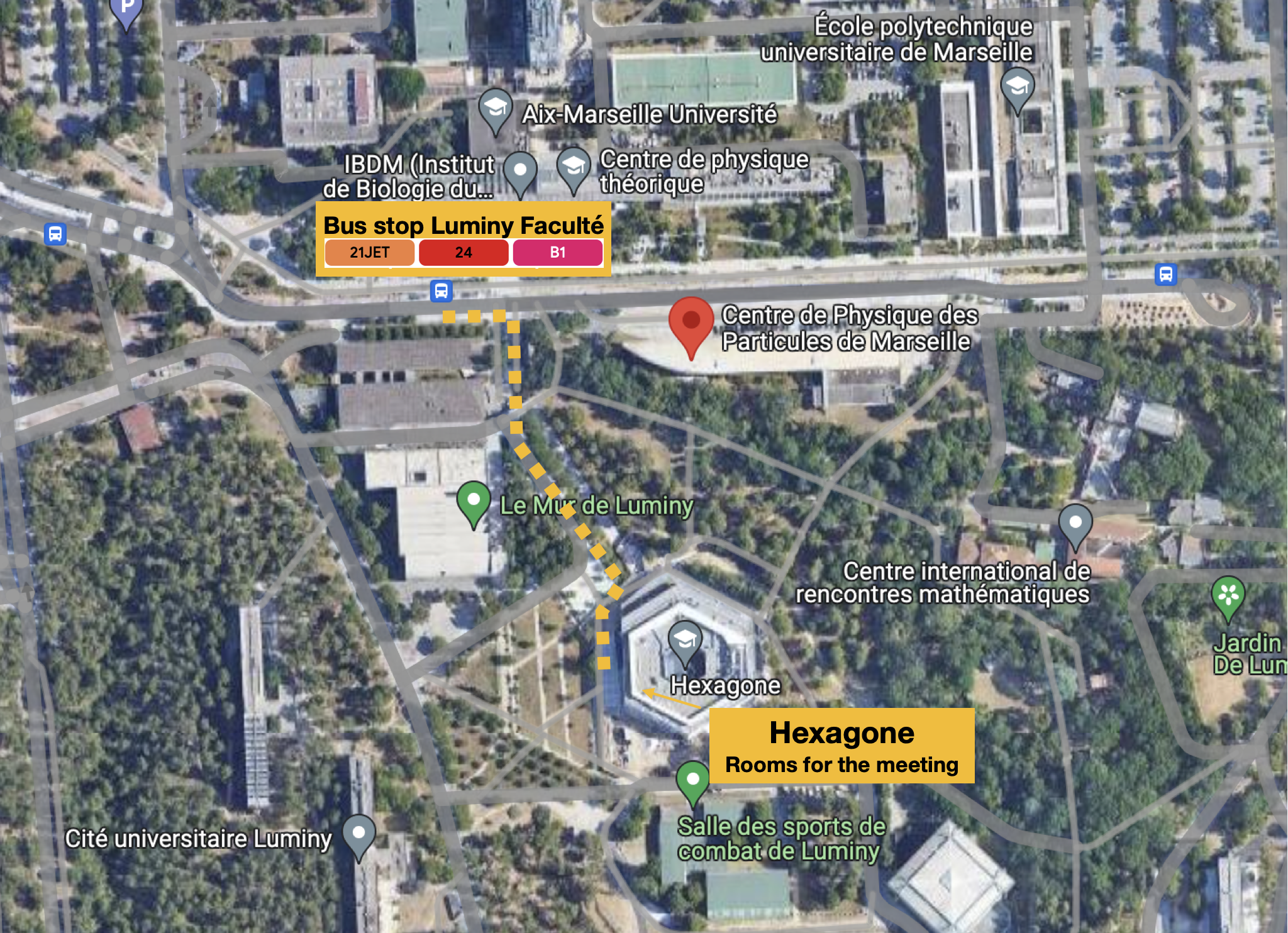
  1. From the city center, take the M2 metro to « Rond Point de Prado », take a look at the vélodrome (allez l’OM !).
  2. Take the bus B1 or the express 21-jet (less frequent).
  3. Go down at Luminy Faculté.


Accomodation

We won't provide accomodation, please check your favorite website. We recommend either to stay on the path to the venue, or in the center of the city: 
  • around the Vieux Port (many options and lively)
  • around Cours Julien (lively and on the metro line)
  • near Castellane/Baille/Rond-Point du Prado metro stations (quicker access to campus)

Contacts

Please contact the SOC and LOC for specific questions:

SOC: Alex Kim, Bastien Carreres, Benjamin Racine, Julian Bautista

LOC: Benjamin Racine, Bruno Sanchez, Corentin Hanser, Dominique Fouchez, Fabrice Feinstein, Julian Bautista, Rafael Kebadian

Inscription
Registration
    • 09:00 09:45
      Plenary: Introduction
    • 09:45 10:40
      Plenary: Science Interests (Lightning talks)
    • 10:40 11:10
      Break 30m
    • 11:10 11:45
      Plenary: Science Interests (Lightning Talks)
    • 11:45 12:30
      Visit of the KM3NET undersea neutrino telescope high bay at CPPM

      M. Markov proposed the principle of an undersea neutrino telescope in 1960. Muon neutrinos traverse the Earth and while going upwards, some convert to muons that cross an array of undersea photosensors. They detect the Cherenkov light produced by muons which allows to infer the direction and the energy of the neutrinos. Since 1995, CPPM has led the effort to build ANTARES, then part of the KM3_Net array near Toulon at 2400 m depth. The lines are presently assembled and tested in the mounting hall of the CPPM.

    • 12:30 13:40
      Lunch 1h 10m
    • 13:40 15:20
      Plenary: Science talks
      • 13:40
        Flip software and applications 20m
        Orateur: Corentin Ravoux (LPC Clermont-Ferrand CNRS/IN2P3)
      • 14:00
        The momentum power spectrum method 20m
        Orateur: Dr Fei QIN (CPPM)
      • 14:20
        Reconstruction PV fs8 20m
        Orateur: Mlle Dane Cross
      • 14:40
        BORG-velocity with ZTF DR2.5 20m

        The Bayesian Origin Reconstruction from Galaxies (BORG) algorithm provides a Bayesian framework to recover the dark matter field through forward modeling of structure formation, accounting for the nonlinear evolution of the velocity field. In this talk, I will present applications of BORG to the ZTF DR2.5 supernova sample, as well as results from realistic ZTF supernova simulations, highlighting its performance in reconstructing the cosmic velocity field.

        Orateur: Mahmoud Ahmed Emam Osman (LPNHE)
      • 15:00
        Blinding for PV studies 20m
        Orateur: Corentin HANSER (CPPM)
    • 15:20 15:50
      Break 30m
    • 15:50 16:10
      Plenary: Science Interests (Lightning Talks)
    • 16:10 16:40
      Plenary: Status of LSST SN Ia PVs
      Présidents de session: Bastien Carreres (Duke University), Corentin Ravoux (LPC Clermont-Ferrand CNRS/IN2P3)
      • 16:10
        Status of LSST SN Ia PVs 30m
        Orateur: Bastien Carreres (Duke University)
    • 16:40 17:40
      Parallel: Discussions on what to do with PV
    • 09:00 10:20
      Plenary: PV surveys
      • 09:00
        ZTF DR2.5 20m
        Orateur: Rafael Kebadian (CPPM)
      • 09:20
        ZTF DR4 20m
        Orateur: Jakob Nordin (Humboldt Universität zu Berlin)
      • 09:40
        WALLABY 20m

        Observations of the Universe indicate that approximately 95% of its content consists of the enigmatic components known as dark matter and dark energy. Understanding the nature of these entities is crucial for elucidating the evolutionary history of the Universe and for testing the validity of General Relativity. One of the most promising approaches to achieving this understanding is through the measurement of the Universe’s large-scale structure via galaxy surveys. This methodology constitutes one of the primary scientific objectives of the WALLABY survey. In this presentation, I will provide an overview of the WALLABY survey, covering its scientific objectives, research team and focus areas, current survey status, and potential future collaborations with LSST.

        Orateur: Dr Fei QIN (CPPM)
      • 10:00
        LS4 20m
        Orateurs: Alex Kim (Lawrence Berkeley National Laboratory), Lluís Galbany (ICE-CSIC)
        LS4
    • 10:20 10:50
      Break 30m
    • 10:50 12:00
      Parallel: Blinding
    • 10:50 12:00
      Parallel: TBD
    • 10:50 12:00
      Parallel: What to do with DESC early data?
    • 12:00 13:30
      Lunch 1h 30m
    • 13:30 15:30
      Plenary: PV surveys
    • 15:30 16:00
      Break 30m
    • 16:00 17:30
      Parallel: Cross-correlate datasets including galaxy surveys: science / methods
    • 16:00 17:30
      Parallel: Follow-up
    • 16:00 17:30
      Parallel: Systematics
    • 20:00 21:00
      Social: Dinner
    • 09:00 10:30
      Plenary: Theory
      • 09:00
        EFT and modeling of PV 20m
        Orateur: Shi-Fan Chen
      • 09:20
        Modeling higher-oder peculiar velocity density correlations 20m
        Orateur: Massimo Guidi (University of Bologna)
      • 09:40
        Anchors no more: Using peculiar velocities to constrain H0 and the primordial Universe without calibrators 20m

        We develop a novel approach to constrain the Hubble parameter $H_0$ and the primordial power spectrum amplitude $A_\mathrm{s}$ using type Ia supernovae (SNIa) data. By considering SNIa as tracers of the peculiar velocity field, we can model their distance and their covariance as a function of cosmological parameters without the need of calibrators like Cepheids; this yields a new independent probe of the large-scale structure based on SNIa data without distance anchors. Crucially, we implement a differentiable pipeline in JAX, including efficient emulators and affine sampling, reducing inference time from years to hours on a single GPU. We first validate our method on mock datasets, demonstrating that we can constrain $H_0$ and $\log 10^{10}A_\mathrm{s}$ within $10\%$ and $15\%$, respectively, using $\mathcal{O}(10^3)$ SNIa. We then test our pipeline with SNIa from an $N$-body simulation, obtaining $6\%$-level unbiased constraints on $H_0$ with a moderate noise level. We finally apply our method to Pantheon+ data, constraining $H_0$ at the $15\%$ level without Cepheids when fixing $A_\mathrm{s}$ to its $\it{Planck}$ value. On the other hand, we obtain $20\%$-level constraints on $\log 10^{10}A_\mathrm{s}$ in agreement with $\it{Planck}$ when including Cepheids in the analysis. In light of upcoming observations of low redshift SNIa from the Zwicky Transient Facility and the Vera Rubin Legacy Survey of Space and Time, surveys for which our method will develop its full potential, we make our veloce code publicly available, and we will describe its features in detail.

        Orateur: Davide Piras (University of Geneva)
      • 10:00
        Optimal Transport Reconstruction of Large-Scale Displacement and Velocity Fields 20m

        The universe we observe today is dotted with galaxy clusters separated by vast voids, in sharp contrast to its initial state, which was nearly uniform with only minor density fluctuations. The evolution from this early uniformity to today's complex structure of galaxies is a profound transformation, with many intermediate processes still unexplained. In this talk, I will explore this transformation, focusing on the reconstruction of the initial density and displacement fields of galaxies observed through spectroscopic surveys. I will present the latest cosmological measurements from the DESI data and discuss advancements in reconstruction algorithms that have enabled significant improvements across several areas, including peculiar velocity analysis and the kinematic Sunyaev-Zel’dovich (kSZ) effect.

        Orateur: Farnik Nikakhtar (Yale University)
      • 10:20
        Skysurvey 10m
        Orateur: Dr Mickael Rigault (IP2I)
    • 10:30 11:00
      Coffee break 30m
    • 11:00 12:15
      Parallel: Beyond linear theory modeling
    • 11:00 12:15
      Parallel: Cross-correlate datasets including galaxy surveys: organisation
    • 11:00 12:15
      Parallel: Simulations
    • 12:15 13:30
      Lunch 1h 15m
    • 13:30 15:30
      Plenary: Summary from parallel + discussion
    • 15:30 16:00
      Break 30m
    • 16:00 17:30
      Plenary: Looking ahead - What is missing and how to collaborate?
    • 09:00 13:00
      Parallel: Sprint Session