
Orateur
Description
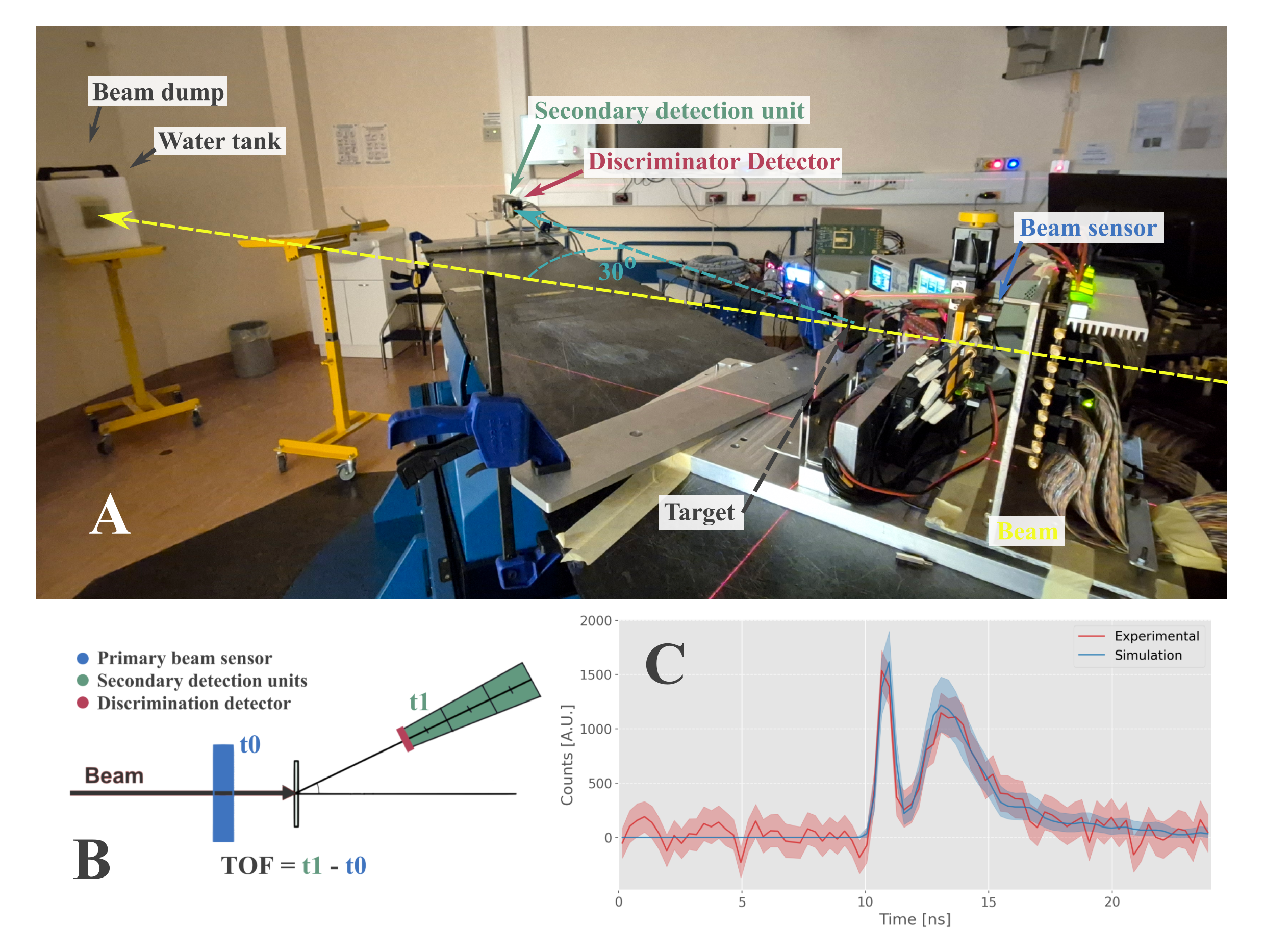
In particle therapy, interactions of primary particles with tissue produce secondary neutrons that contribute to the out-of-field dose and increase long-term cancer risks in the patient. In space radiation, galactic cosmic rays interacting with spacecraft walls also generate neutrons, which represent a significant fraction of astronaut exposure. In both scenarios, neutron spectra by fragmentation are dominated by fast neutrons with energies between 200 keV and 500 MeV, underscoring the need for dedicated neutron detectors in this energy range. The Prompt Gamma Timing (PGT) system developed within the INFN SIG_PNR project was recently demonstrated to be sensitive to fast neutrons. Originally designed for range verification in particle therapy, it measures the delivery time of each primary particle together with the detection time of the corresponding secondary radiation produced from nuclear interactions in the target material. Building upon the PGT approach, the present study introduces a novel method to measure neutron production from fragmentation events using a dedicated Time-Of-Flight (TOF) multi-detector setup with advanced Photo-Detector technology and high-fluence rate operation. A complete data analysis pipeline is presented, based on preliminary experimental measurements carried out at CNAO (Pavia, Italy) with a 398.84 MeV/u carbon ion beam irradiating a 5 mm graphite target, highlighting the need for high-performance timing from the Photo-Detectors to achieve an overall time resolution of ~150 ps. Monte Carlo (MC) simulations performed with FLUKA supported the analysis. The proposed setup comprises a beam sensor for monitoring the incident primary particle beam, an array of detection units to record secondary particle signals, and a discriminator detector for rejecting charged particles. The beam sensor, developed by the INFN Torino group within the MoVe-IT project, is based on a modified LGAD design without the gain layer (PIN-like) and has 8 instrumented silicon strips with an active area of 2.2 mm² (4 mm × 0.55 mm) and a 60 µm-thick active area. Strips discriminate single particles with about 30 ps temporal resolution. The secondary detection units will consist of an array of LaBr3:Ce scintillating crystals (5 units, cubic shape to allow array arrangement, 1-inch side) coupled to Silicon Photomultipliers (NUV-HD Metal in Trench (MT), 8x8 matrix, 3 mm pitch, 50 µm microcells). Finally, a thin plastic scintillator (25 × 25 × 2 mm3) read out by SiPMs should be placed in front of the array, serving as a veto discriminator detector for charged secondary particles.
| Title | Photo-Detector requirements for high-performance neutron identification in fragmentation events. |
|---|---|
| Topic | Photosensors |